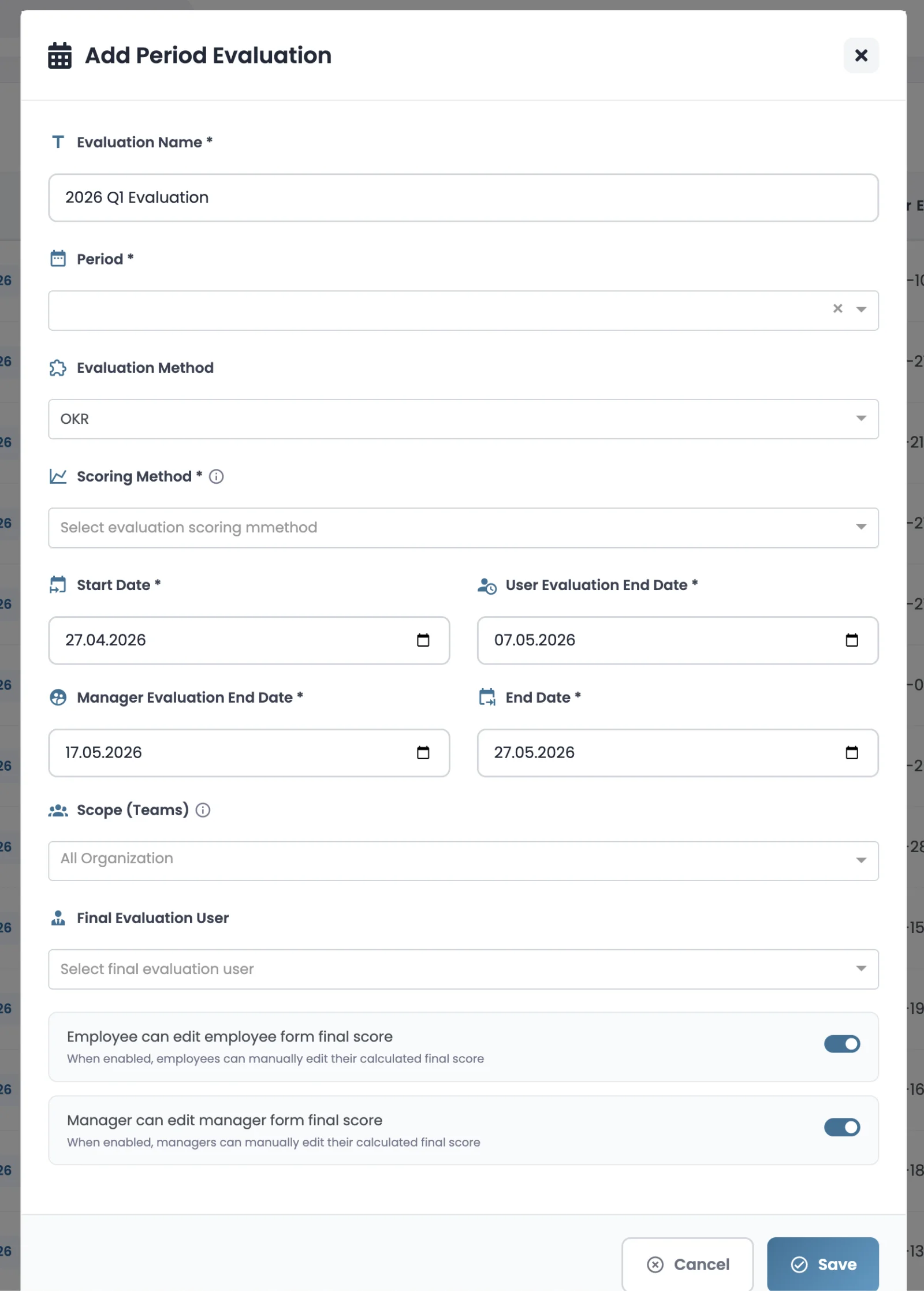
Run year-end, quarterly or custom performance reviews on a single platform, side-by-side with OKR scores and competency ratings. You set the weights, the system runs the math.
An employee's OKR progress (including manager scoring) and competency ratings combine with weights into a single performance score. The system runs the math.
Companies can use both OKR scores and competencies with separate weights in their annual or quarterly performance reviews. The result is a single consolidated score.
| Source | Raw Score | Weight | Result |
|---|---|---|---|
| OKR Score3 OKRs · 9 KRs · manager scoring included | 85 | 70% | 60 |
| Competency Score5 competencies · self + manager rating | 78 | 30% | 23 |
Every period opens two forms per employee. The manager's score stays hidden from the employee until the manager form is finalized. The order keeps self-evaluation independent of manager scoring.
The performance review flows through four roles. The calibration step is optional and can be skipped.
Modern practice combines both. Quarterly reviews maintain a continuous record of progress, give faster feedback, and let teams course-correct between cycles. The annual review then serves as a summary moment for compensation and promotion decisions, drawing on the data collected throughout the year. Devokr supports both cadences in the same workflow.
Performance review calibration is the process of aligning manager ratings before they are finalized, so a "meets expectations" or "exceeds expectations" rating means the same thing across teams. Managers and HR leaders compare ratings, debate edge cases, and adjust outliers to reduce bias and ensure consistency before the cycle closes.
Most companies tie annual reviews to compensation, but quarterly check-ins are kept separate. Mixing the two cycles makes feedback conversations defensive and adds workload on managers. Best practice: keep continuous check-ins and OKR scores out of compensation, and use the annual review as the single moment that translates a year of evidence into pay decisions.
Weighted scoring lets you give different parts of a review different importance. For example, OKR outcomes might count 40%, competencies 40%, and 360° feedback 20%, depending on the role. Devokr supports custom weights per template, so the final score reflects your company's priorities rather than a generic blend.
Yes. Devokr brings OKR scores, competency ratings, and 360° feedback into one review form. The OKR score answers what the person achieved, the competency rating answers how they did it, and 360° feedback adds peer perspective. Combined, they replace the single subjective manager rating with structured evidence.
Run year-end, quarterly or custom performance reviews on a single platform, together with OKR and competency scores. Free up to 10 users.