Add your objectives and key results, measure your progress instantly with our OKR score calculator tool.
Start CalculatingOKR scoring measures how much progress each Key Result has made toward its target. Most teams use a 0-100% scale; Google uses the 0.0-1.0 format where 0.7 signals strong performance.
The formula is simple: (Current Value - Start Value) / (Target Value - Start Value). When Key Results carry different importance, enable weighted scoring to reflect each one's true impact on the Objective.
Scoring 70% on an OKR is a win, not a failure. OKR targets are intentionally ambitious. Consistently hitting 100% means your goals are too safe and you are not stretching enough.
Click the button below to start tracking your OKR progress.
Select an objective from the left panel or add a new one.
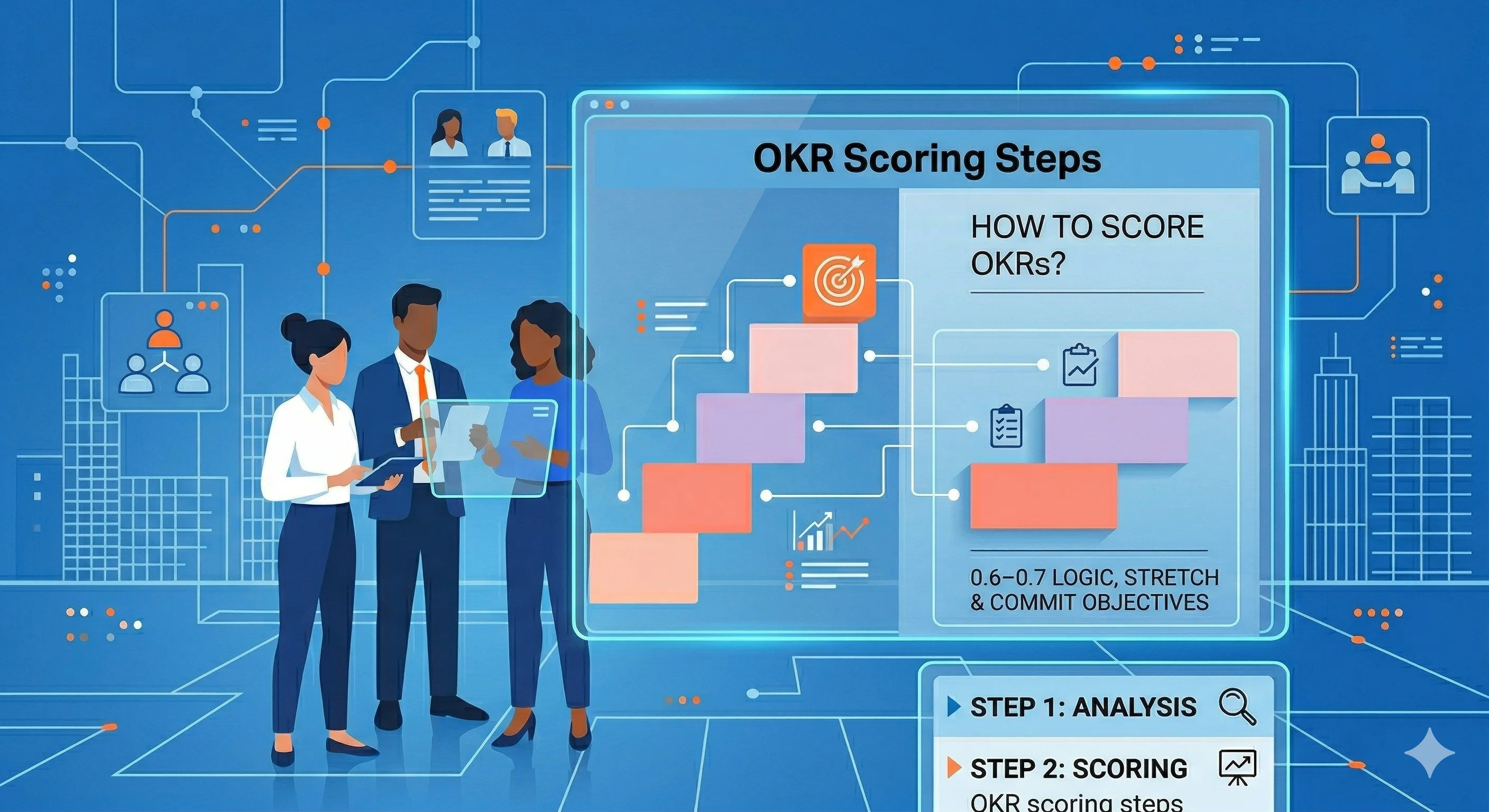
A good OKR score typically falls between 0.6 and 0.7 on a 0.0–1.0 scale. Scoring in this range means you set ambitious enough targets while still making meaningful progress. Consistently hitting 1.0 signals your objectives were too easy.
OKR progress is calculated by averaging the completion percentages of all Key Results under an Objective. Each Key Result gets a score based on actual achievement versus the target. Weighted scoring can be applied when Key Results carry different importance.
No. If every Key Result hits 100%, your targets were not ambitious enough. OKR methodology distinguishes between committed OKRs (expected to reach 100%) and aspirational OKRs (where 60–70% achievement is a strong result).
Google popularized scoring each Key Result from 0.0 (no progress) to 1.0 (fully achieved). Scores of 0.0–0.3 mean insufficient progress, 0.4–0.6 indicate partial achievement, and 0.7–1.0 represent strong delivery. Google considers 0.6–0.7 the ideal zone.
Update OKR scores weekly or biweekly during check-in meetings. Waiting until the end of the quarter turns scoring into a post-mortem instead of a steering tool. Regular updates let teams spot blockers early and course-correct while there is still time.
Automate your OKR scoring, check-ins, and alignment with DevOKR.