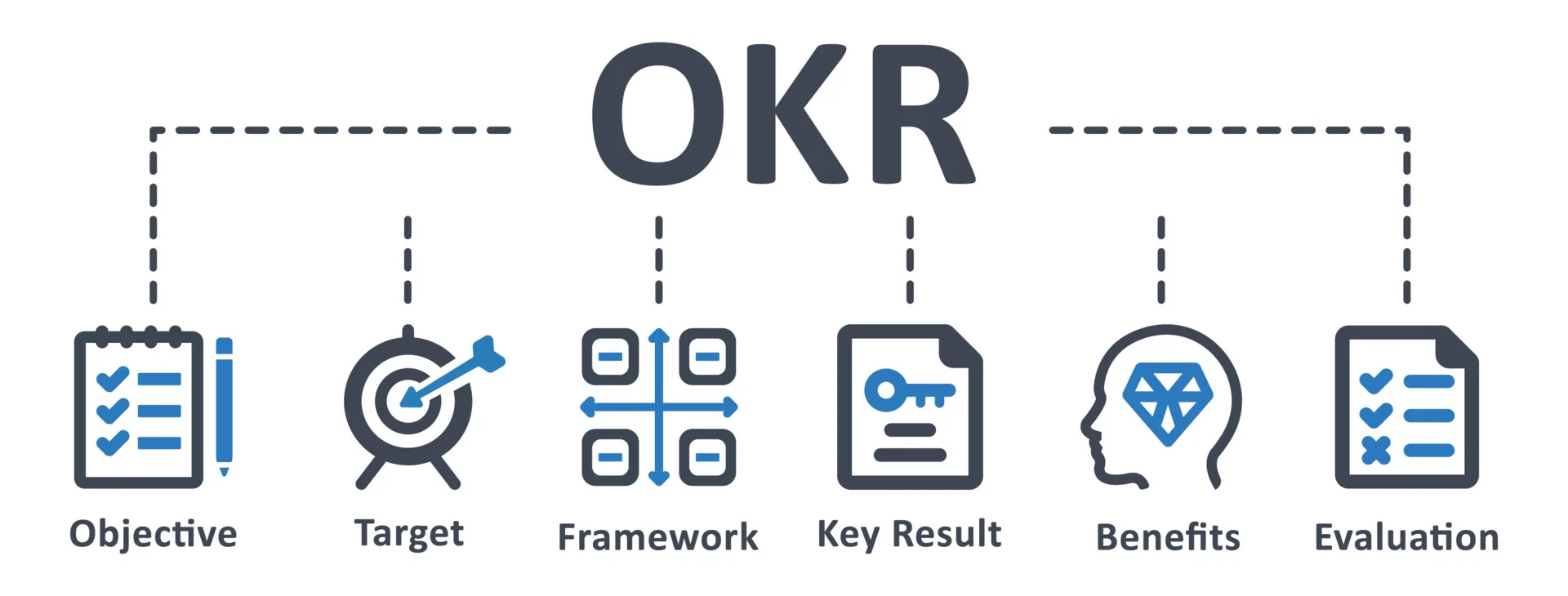
OKR Guide: A Complete Framework for Implementation and Adoption

 OKR-BOK™ Certified Coach
Successful OKR programs share three traits: clear strategic direction at the top, team ownership of objectives, and a weekly cadence that catches problems early. Without these, OKRs become quarterly paperwork instead of a strategic execution methodology.
Nearly half of all Fortune 500 companies now use OKRs as their primary goal-setting framework, and the global OKR software market is projected to reach $3.27 billion by 2032. Yet most organizations admit they have not yet fully mastered implementing the methodology. The gap between adoption and mastery is where most OKR programs live.
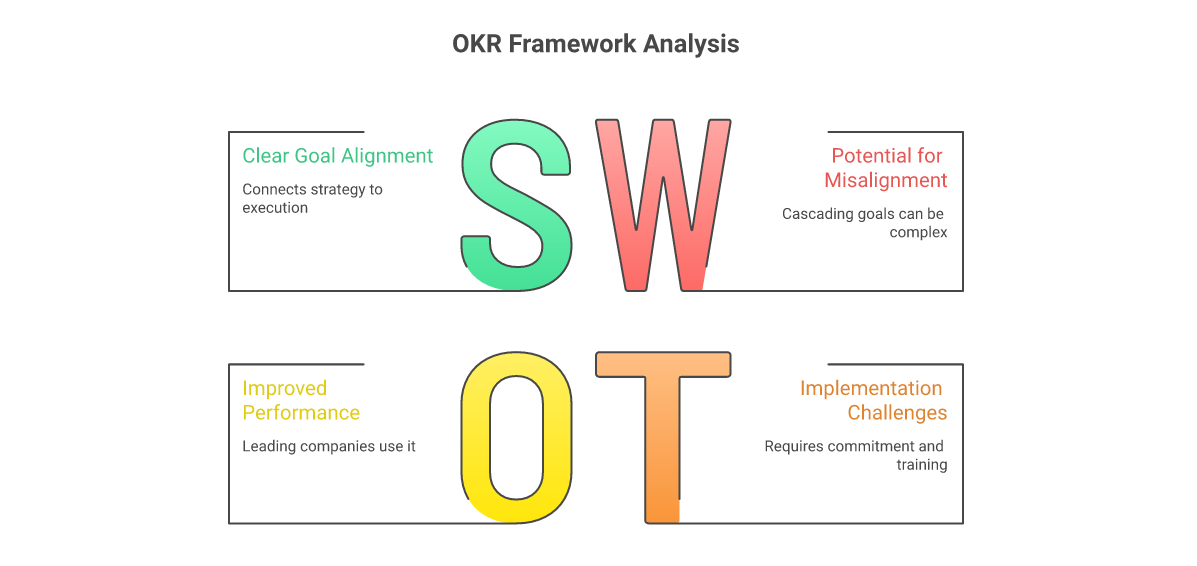
OKR at a Glance
OKR stands for Objectives and Key Results. It is a collaborative goal-setting framework that connects ambitious, qualitative goals (Objectives) to specific, measurable outcomes (Key Results). The formula is simple: "We will [Objective] as measured by [Key Results]." Typically, each level of an organization defines 3-5 Objectives, with 3-4 Key Results per Objective, reviewed on a quarterly cycle.
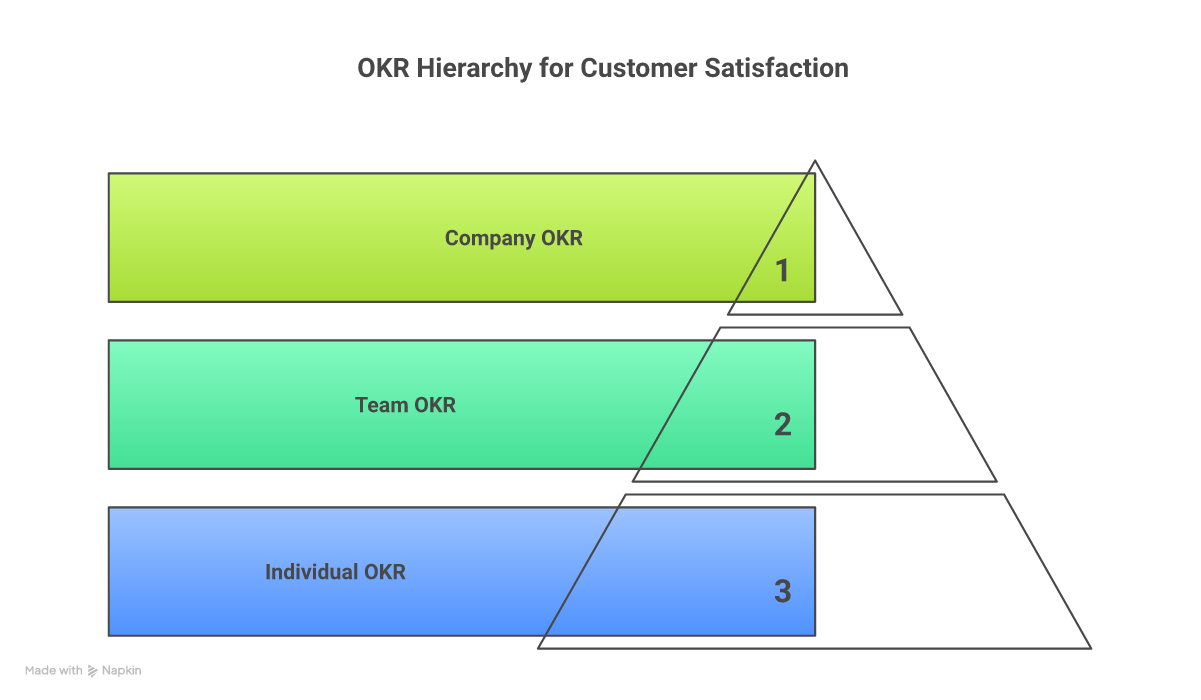
What makes OKR different from other frameworks is its emphasis on transparency, alignment, and stretch goals. Every OKR is visible across the organization, from the CEO to individual contributors. This radical transparency creates a shared understanding of priorities and fosters accountability without micromanagement.
Industry surveys consistently report that the majority of companies adopting OKRs feel the methodology meets or exceeds their expectations.
The Evolution of OKR: From Intel to Global Adoption
The roots of OKR trace back to Peter Drucker's Management by Objectives (MBO) in the 1950s. Andy Grove refined this concept at Intel during the 1970s, creating what he called "iMBOs", a faster, more transparent version focused on measurable outputs rather than activities. The true inflection point came in 1999, when venture capitalist John Doerr introduced OKRs to a 40-person startup called Google.
Google's extraordinary growth, from a garage project to a trillion-dollar company, became one of the most powerful examples of the OKR methodology. Today, major enterprises including LinkedIn, Netflix, Spotify, and Amazon use OKRs as a core part of their strategy execution, and search interest in the framework has grown substantially over the last decade.
From Google and Intel to LinkedIn and Netflix, OKRs have become a defining management practice in how companies execute strategy.
How to Write Effective OKRs That Drive Results
Writing strong OKRs is the single most important skill in the entire methodology. A well-crafted Objective should be qualitative, inspirational, time-bound, and actionable by the team. It answers the question: "Where do we want to go?" Key Results, on the other hand, must be quantitative, specific, and verifiable. They answer: "How will we know we got there?"
The most common mistake in OKR writing is confusing Key Results with tasks. A Key Result measures an outcome ("Increase customer NPS from 32 to 45"), not an activity ("Launch a customer survey"). Keeping this distinction clear is essential for the framework to deliver real business impact.
Industry research, including Mooncamp's 2022 OKR Impact Report, shows that nearly all OKR initiatives are introduced through executive leadership, making top-down clarity in OKR writing critical for success.
Understanding OKR Scores: The 0.0–1.0 Scale
At the end of each quarter, every Key Result receives a score between 0.0 and 1.0. A score of 0.0 means no progress was made; 1.0 means the target was fully achieved. The OKR methodology does not reward 1.0 scores: in fact, consistently scoring 1.0 is a signal that goals are not ambitious enough. A healthy OKR score falls between 0.6 and 0.7: teams reached significantly beyond their comfort zone without consistently failing. This scoring philosophy is fundamental to creating a culture of stretch goals rather than safe ones.
OKR Scoring: Closing the Loop and Learning from Results
Most teams treat OKR scoring as the last task of a quarter: fill in the numbers, move on. But in high-performing organizations, the score is where the real OKR work begins. When a team scores 0.4 on a Key Result, the number alone tells you almost nothing. The conversation it sparks tells you everything: Was the goal set too aggressively? Were there resource constraints? Did market conditions shift? Did the team learn something that changes the strategy for next quarter?
The Score Is the Input for the Next Cycle
The OKR cycle is a learning loop: set, execute, score, reflect, then set again. Skipping or rushing the scoring phase breaks this loop. The score is the raw material that makes next quarter's OKRs sharper, better calibrated, and more honest about both ambition and constraints. Organizations that skip rigorous end-of-quarter scoring tend to repeat the same strategic mistakes cycle after cycle because they never close the feedback loop.
A Score Is a Conversation Starter, Not a Verdict
The 0.6–0.7 sweet spot is not a passing grade: it signals that the team stretched into uncomfortable territory and came back with real learning. A 0.3 on a stretch goal is not failure; it is data. A 1.0 on a committed goal is expected; a 1.0 on a stretch goal raises a question. Treating scores as performance verdicts pushes teams toward easy goals. Treating them as prompts for honest reflection creates the conditions where people actually think big.
OKR vs KPI and Traditional Goal Setting: Understanding the Differences
OKR and KPI are complementary tools, not competitors. KPIs are the dashboard gauges that measure the ongoing health of your business and tell you if something needs attention. OKRs, by contrast, are the navigation system that sets direction and tells you where to go next. The best organizations use both: KPIs to monitor, OKRs to transform.
| Aspect | OKR | KPI | Traditional |
|---|---|---|---|
| Focus | Ambitious transformation | Ongoing health metrics | Annual fixed targets |
| Cycle | Quarterly | Continuous | Annual |
| Direction | Bottom-up and top-down | Top-down | Top-down only |
| Transparency | Fully visible to all | Department-level | Manager-employee only |
| Linked to Pay | No (decoupled) | Often yes | Yes (bonus-linked) |
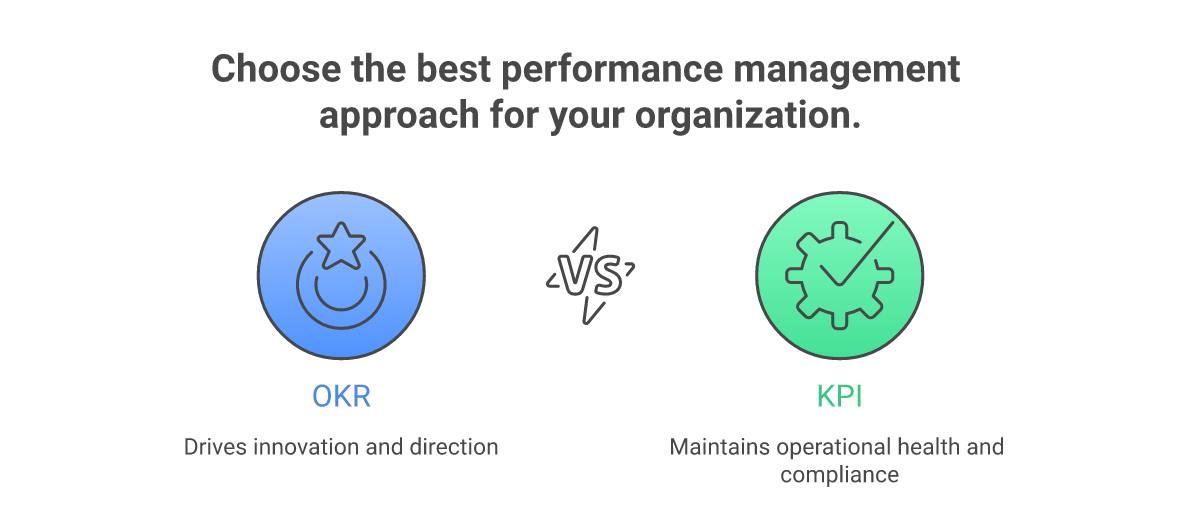
Traditional performance management ties goals to annual reviews and compensation, creating risk-averse cultures. OKR decouples goal-setting from pay, encouraging teams to set ambitious stretch goals without fear of punishment for falling short. A score of 0.6-0.7 out of 1.0 is considered healthy in OKR, signaling that teams are reaching beyond the comfortable.
Why OKR Works: 6 Key Benefits for Any Organization
Understanding the mechanics of OKR is important, but the real question is why OKR consistently outperforms other goal frameworks. The answer lies in six structural advantages that are built into the methodology itself.
Radical Focus
By limiting Objectives to 3-5 per level, OKR forces organizations to make explicit choices about what matters most. This discipline of saying no, even to good ideas, is what allows companies to move faster and achieve more with the same resources.
Organization-Wide Alignment
OKR creates a clear line of sight from company strategy to individual contribution. Every team member can see how their work connects to the company's most important priorities, eliminating the silo effect that slows most large organizations.
Built-In Agility
Quarterly OKR cycles mean organizations review and adjust direction four times a year instead of once. This cadence makes it possible to respond to market changes, competitive shifts, and internal learnings without waiting for the annual planning cycle.
Radical Transparency
In most OKR implementations, all goals are visible to everyone in the organization. This transparency eliminates duplicate efforts, reveals dependencies between teams, and creates social accountability that drives completion rates.
Intrinsic Motivation
When employees participate in setting their own goals rather than having targets imposed from above, engagement increases significantly. OKR's bottom-up component gives people ownership over their work and a direct stake in outcomes. This dynamic is the foundation of intrinsic motivation at work.
Data-Driven Decision Making
Every Key Result requires a number. This discipline forces organizations to define success in measurable terms before they begin working, making it possible to evaluate progress objectively rather than through subjective perceptions.
The arguments for OKR are not abstract: organizations that move from annual to quarterly goal-setting periods much more consistently report better execution and higher engagement, and employees who understand how their work connects to company strategy are measurably more invested in outcomes. Companies like Google, LinkedIn, and Spotify attribute much of their execution discipline to OKR adoption. OKR becomes this important not because it's magic, but because it forces the conversations about priority that most organizations avoid.
Implementation Roadmap: From Zero to Full OKR Adoption
Successfully implementing OKRs in your organization is not an overnight task. It typically takes 3-4 quarters of phased work to reach maturity. Based on patterns from hundreds of successful implementations, here is the proven roadmap:
Phase 1: Foundation (Weeks 1-4)
Ensure OKRs will be implemented company-wide, because OKR adoption fails without visible leadership commitment. Train the executive team on the methodology, designate an internal OKR champion or hire an OKR coach, and define your first company-level Objectives. Start with just 2-3 Objectives at the company level. Hold off on involving departments at this stage.
Phase 2: Pilot (Weeks 5-12 / Quarter 1)
Select 2-3 departments for a pilot program, and let these teams write their own OKRs aligned with company Objectives. Establish a weekly check-in rhythm and designate OKR ambassadors in each pilot team. Use suitable OKR software to maintain visibility and track progress. At the end of the quarter, run a formal retrospective to identify what worked and what needs adjustment.
Phase 3: Expansion (Quarter 2-3)
Roll out OKRs to all departments based on learnings from the pilot. Introduce cross-functional alignment, as departments should identify shared Key Results that connect their work horizontally. Train managers on facilitating OKR check-ins and giving OKR-focused feedback. In this phase, the focus shifts from "writing correct OKRs" to "operating OKRs as a regular cycle": quarterly planning, weekly check-ins, and end-of-quarter reflection.
Phase 4: Maturity (Quarter 4+)
OKRs become embedded in company culture, and individual contributors write their own OKRs aligned with team and company goals. Data from previous cycles drives better goal-setting, and advanced practices emerge: aspirational OKRs, learning OKRs, and OKR-driven resource allocation. The system becomes self-sustaining, with the OKR champion shifting from facilitator to optimizer.
Industry data indicates that around half of companies using OKRs have adopted the framework within the last three years, meaning most organizations are still in the expansion or early maturity phase.
The OKR Operating Rhythm: Check-ins, Feedback and Alignment
The real power of OKR is not in the goal-setting but in the rhythm of continuous follow-through. Three interconnected practices form the operating backbone: regular check-in meetings that track progress and remove blockers, structured feedback loops that develop people alongside performance, and strategic alignment that ensures every team pulls in the same direction.
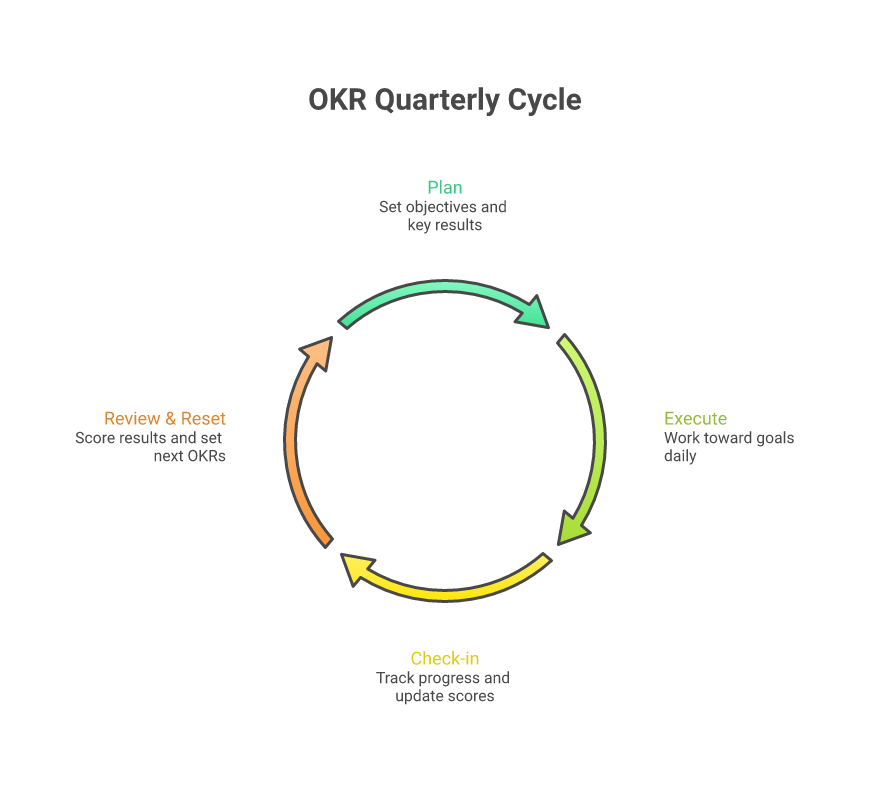
Without regular check-ins, even perfectly written OKRs gather dust. Without feedback, teams repeat mistakes. Without alignment, departments optimize locally at the expense of the whole. These three pillars transform OKR from a quarterly planning exercise into a living management system.
Check-in Meetings
Weekly or biweekly sessions where teams review Key Result progress, flag blockers, and adjust priorities. The most effective check-ins take 15-30 minutes and follow a three-phase structure: progress review (what moved), blockers and confidence levels (what is stuck), and next-meeting commitments (what will move next). This format keeps conversations focused and prevents check-ins from drifting into status-update theater.
Structured Feedback
Feedback tied to OKR progress helps employees understand not just what they achieved, but how they can improve. Most feedback cultures fail because organizations treat feedback as an annual event rather than a continuous practice. Adopting CFR (Conversations, Feedback, and Recognition) alongside OKR transforms feedback from a dreaded ritual into a natural part of weekly work. Peer and upward feedback are equally important: teams that rely solely on top-down feedback miss critical blind spots that only colleagues at the same level can see.
Strategic Alignment
Vertical alignment connects individual goals to company strategy. Horizontal alignment ensures cross-functional teams share common Key Results. Both are essential for enterprise-wide execution.
Team Participation
OKR works best when team members participate in setting their own goals rather than having them imposed from above. A practical guideline is the 60/40 rule: roughly 60% of OKRs should emerge from the team (bottom-up) and 40% should cascade from leadership (top-down). This balance ensures strategic alignment without killing ownership. When participation is purely mechanical (people fill in OKR templates without genuine input), engagement drops and OKR becomes just another compliance exercise.
Prioritization
OKR forces prioritization by design. Limiting Objectives to 3-5 per level means saying no to good ideas in favor of great ones. When teams struggle to prioritize, frameworks like the Eisenhower Matrix can help separate truly important work from merely urgent tasks. The real test comes mid-quarter, when new requests compete with existing OKRs. High-performing teams evaluate incoming work against their Key Results and protect their OKR commitments unless the business context has fundamentally changed.
Common OKR Mistakes and Proven Best Practices
Even experienced organizations stumble with OKR. The most frequent pitfalls include setting too many Objectives (diluting focus), writing Key Results that are really tasks (measuring activity instead of outcomes), failing to follow up after the quarterly kickoff (the "set and forget" trap), and tying OKR scores directly to compensation (which kills ambition).
On the flip side, the best practices that consistently drive OKR success include: limiting Objectives to 3-5 per level, ensuring every Key Result has a number, conducting weekly check-ins, scoring OKRs at end of quarter, running a retrospective before setting new OKRs, and keeping OKRs visible to the entire organization. These are not theoretical recommendations, but patterns observed in companies that have used OKRs successfully for years.
A useful habit is to run a quarterly OKR health check before each new cycle. Ask five questions: Can every team member name their top Objective from memory? Do our Key Results measure outcomes rather than tasks? Are check-ins happening consistently? Do teams adjust OKRs mid-quarter when the context changes? Is there visible leadership involvement? If the answer to three or more is "no," the system needs attention before new OKRs are set. It is also worth noting that OKR responsibility is not evenly distributed: executives set the strategic direction, managers translate it into actionable team OKRs and remove blockers, individual contributors own execution, and OKR champions maintain the rhythm across the organization.
OKR by Department: Marketing, HR and Product Development
OKR adapts to every department, but the implementation nuances differ significantly. Marketing teams use OKRs to drive measurable growth. HR teams leverage OKRs to synchronize people strategy with business goals. Product teams rely on OKRs to prioritize customer-centered innovation over feature lists.
Here are concrete OKR examples for the three most commonly asked-about departments:
| Department | Objective | Key Results |
|---|---|---|
| Marketing | Establish the brand as the leading authority in our market segment |
|
| Human Resources | Transform HR into a strategic growth partner for the business |
|
| Product Development | Ship a product experience that users genuinely love |
|
| Sales | Build a pipeline where deal quality matters more than deal volume. |
|
| Engineering | Make the platform effortless to scale for the next growth phase. |
|
Marketing
Marketing OKRs shift the conversation from "how many campaigns did we run?" to "what business impact did our marketing create?" This outcome-first thinking transforms marketing from a cost center to a growth engine.
Human Resources
HR OKRs connect talent strategy to corporate goals. When HR moves beyond operational tasks to strategic goal-setting, it becomes a true business partner that speaks with evidence and builds organizational trust.
Product Development
Product OKRs anchor development teams to customer outcomes rather than feature delivery. By measuring success through customer satisfaction, adoption rates, and usage metrics, product teams stay focused on what truly matters.
OKR for Different Team Types: Agile, Remote, Startups and Enterprise
The way OKR is implemented varies by team structure, company size, and work model. Agile teams integrate OKR with sprint cycles. Remote teams use OKR as their alignment lifeline. Startups rely on OKR to maintain focus during chaotic growth. Technology companies leverage OKR to balance innovation with execution.
Agile Teams
OKR provides the strategic compass that complements Agile's tactical flexibility. The critical distinction is that sprints produce outputs (shipped features) while OKRs track outcomes (business impact). Integrating the two does not require new meetings. Sprint planning already asks "what will we build?" and adding "which Key Result does this serve?" takes seconds but fundamentally changes the conversation. Teams that skip this connection risk becoming feature factories: shipping fast without knowing whether any of it matters.
Remote and Hybrid Teams
For distributed teams, OKR replaces the informal alignment that happens in physical offices. Visible goals and regular check-ins create structure and accountability across time zones.
Startups
Startups face the paradox of limitless possibilities and limited resources. OKR forces the discipline of focus, helping founding teams say no to distractions and yes to sustainable growth. What a startup measures should evolve with its stage: pre-seed teams focus on validation signals (user interviews, retention), seed-stage companies track product-market fit metrics (MRR, activation rates), and Series A organizations measure scalable growth. Beyond internal clarity, a functioning OKR practice also serves as a credibility signal to investors: it demonstrates execution discipline that most early-stage companies lack.
Technology Companies
Tech companies use OKR to manage the tension between innovation and reliability. Strategic OKRs drive exploration, while operational OKRs protect the core product.
Personal and Career OKRs: Goal Setting Beyond the Office
OKR is not limited to corporate strategy. The same framework that helps Google organize its priorities can help individuals structure their career development and personal growth. Career OKRs connect daily work to long-term professional aspirations, making career planning transparent and actionable rather than a vague annual conversation with your manager. Importantly, career OKRs look different at each seniority level: junior professionals focus on skill mastery and cross-team exposure, mid-level employees shift toward leadership and specialization, and senior leaders concentrate on strategic influence and knowledge multiplication.
Personal OKRs apply the methodology to life goals: fitness, learning, relationships, financial health. The key is choosing objectives that genuinely matter to you, not copying someone else's template. A common mistake is setting too many personal OKRs at once; start with one objective in one life area, build the review habit, and expand from there. John Doerr himself uses personal OKRs to manage his time and priorities outside of work, demonstrating that the framework scales from Fortune 500 boardrooms to individual daily routines.
Company Success Stories: How Industry Leaders Use OKR
The most compelling evidence for OKR comes not from theory but from practice. Here are the organizations that have shaped the methodology and proven its impact at scale:
Intel: Where It All Began
Andy Grove developed OKR at Intel in the 1970s as a faster alternative to MBO. The OKR framework helped Intel maintain strategic focus during its critical transition from memory chips to microprocessors, a pivot that saved the company and eventually made it the world's most valuable chipmaker. Grove's key insight was that goals should be public, measurable, and frequently reviewed rather than annual secrets between manager and employee.
Google: The Growth Engine
John Doerr introduced OKRs to Google in 1999, when the company had just 40 employees. Larry Page and Sergey Brin adopted the OKR framework immediately, and it became part of Google's DNA. Every Googler sets individual OKRs each quarter, visible to the entire company. Google credits OKR with helping them maintain focus and alignment through hyper-growth, from 40 people to over 180,000 employees.
LinkedIn: Scaling People Operations
LinkedIn adopted OKRs to align its rapidly growing teams around shared priorities. Jeff Weiner, former CEO, used OKRs to ensure that product development, engineering, and sales teams worked toward the same goals. The transparency of OKRs helped break down silos that naturally form in fast-growing companies.
Spotify: OKR Meets Squad Culture
Spotify adapted OKR to fit its unique squad-based organizational model. Each squad sets its own OKRs aligned to tribal and company priorities. This bottom-up approach preserves team autonomy while ensuring strategic coherence. Spotify's experience shows that OKR is not a rigid system: it can be adapted to fit different organizational cultures and structures.
Netflix: Selective Application
Netflix uses a modified version of OKRs focused on key strategic bets rather than company-wide adoption. Their approach demonstrates that OKR does not have to be an all-or-nothing decision. Organizations can adopt the framework selectively, applying it to strategic priorities while using lighter approaches for operational work.
According to market research, the OKR software market grew from $1.36 billion in 2024 to $1.6 billion in 2025, reflecting a 17.1% year-over-year growth rate as more companies formalize their OKR processes.
OKR in 2026: AI Integration, Market Trends and the Future
The OKR landscape is evolving rapidly, driven by AI capabilities, remote work demands, and a growing body of implementation data. Here are the trends shaping how organizations will use OKR in 2026 and beyond:
AI-Powered OKR Tools
AI is transforming OKR management from a manual process to an intelligent system. Modern OKR software can suggest Key Results based on historical data, predict goal achievement probability, identify misalignment before it becomes a problem, and auto-generate progress reports from connected data sources. This significantly reduces the administrative burden of OKR management, letting teams focus on execution rather than tracking.
Continuous OKR: Beyond Quarterly Cycles
While quarterly cycles remain the standard, leading organizations are experimenting with shorter OKR cycles for fast-moving teams. Monthly OKRs for product teams, bi-annual OKRs for strategic initiatives, and rolling OKRs that refresh mid-quarter when market conditions change are emerging patterns that reflect the accelerating pace of business.
Market Growth and Enterprise Adoption
According to market research, the global OKR software market is projected to reach $3.27 billion by 2032, growing at a 13.5% CAGR. This growth is driven by enterprise adoption: large companies are moving from spreadsheet-based OKR tracking to dedicated platforms that integrate with their existing HR and project management tools.
OKR Coaching and Expert Guidance
As OKR adoption accelerates, the demand for specialized OKR coaches and consultants is growing. Organizations are recognizing that the framework is simple to understand but difficult to master. Professional OKR coaches bring cross-industry experience, objective assessment capabilities, and proven facilitation techniques that dramatically accelerate the journey from adoption to mastery.
OKR for Succession Planning
A strategic application of OKR is in succession planning. Organizations use OKR to convert succession readiness from an annual assessment into a quarterly tracked outcome, identify high-potential successors through dual judgment (performance and readiness), and close the gap between named candidates and ready leaders. This elevates HR from an administrative function to a strategic continuity partner.
The global OKR software market is projected to reach $3.27 billion by 2032, up from $1.36 billion in 2024, with a compound annual growth rate of 13.5%.
Ideas are easy. Execution is everything.
— John Doerr, Author of "Measure What Matters"
Start Your OKR Journey Today
OKR is more than a goal-setting framework: it is a management philosophy that prioritizes focus, transparency, and continuous learning. Whether you are a startup founder defining your first Objectives or an enterprise HR leader scaling OKRs across thousands of employees, the principles remain the same: set ambitious goals, measure what matters, review progress regularly, and adapt based on what you learn.
The organizations that succeed with OKR are not the ones that write the most sophisticated goals. They are the ones that build the discipline of regular check-ins, embrace transparency, and treat each quarterly cycle as an opportunity to get better. The best time to start your OKR journey was last quarter. The second best time is now.
Ready to bring OKR to your organization? DevOKR helps companies of all sizes implement, track, and master the OKR framework with enterprise-grade software and expert guidance.
Frequently Asked Questions
What is OKR and why does it work?
OKR, which stands for Objectives and Key Results, is a goal management framework that pairs inspiring qualitative goals with concrete, trackable metrics. The core logic fits a single sentence: 'We will achieve this Objective, and we will verify it through these Key Results.' Its power comes from forcing clarity about both direction and evidence of progress.
What makes a good Objective?
A good Objective is qualitative, inspirational, time-bound, and actionable by the team. It answers the question: 'Where do we want to go?' It should be short, memorable, and motivating. Objectives do not contain numbers or percentages — measurement belongs to Key Results. Typically, 3-5 Objectives are set per level of the organization each quarter.
What makes a good Key Result?
A good Key Result is quantitative, specific, and verifiable. It answers: 'How will we know we got there?' It must include a metric, a starting value, and a target value. 'Increase customer NPS from 32 to 45' is a strong Key Result. 'Improve customer satisfaction' is not — it cannot be scored definitively. Key Results measure outcomes, not activities. Launching a campaign is a task; increasing trial signups by 30% is a Key Result.
How often should OKRs be set?
OKRs are typically set on quarterly cycles, linked to annual strategic goals. The quarterly cadence allows organizations to review and adjust direction four times a year instead of once. Weekly or biweekly check-in meetings keep OKRs alive between planning cycles. Some fast-moving teams experiment with monthly OKRs, but the quarterly cycle remains the standard and is recommended for most organizations starting out.
What is CFR in OKR?
CFR stands for Conversations, Feedback, and Recognition. It is the human side of OKR that transforms goal tracking into a continuous development culture. CFR moves feedback from an annual event to a natural part of weekly work. Managers coach rather than judge, asking 'How can I support you to reach this goal?' Recognizing progress publicly — not just final outcomes — builds the psychological safety that makes stretch goals possible.
How do you score OKRs?
Each Key Result receives a score between 0.0 and 1.0 at the end of every quarter. A score of 0.0 means no progress; 1.0 means the target was fully achieved. A healthy OKR score is 0.6-0.7 — the team aimed high and achieved meaningful progress. Consistently scoring 1.0 is a warning signal that goals are not ambitious enough. This scoring philosophy is what creates a culture of stretch goals rather than comfortable, predictable targets.
Start Using DevOKR Today, Free
Turn what you've read into action. Write your first OKR in minutes, free for small teams.