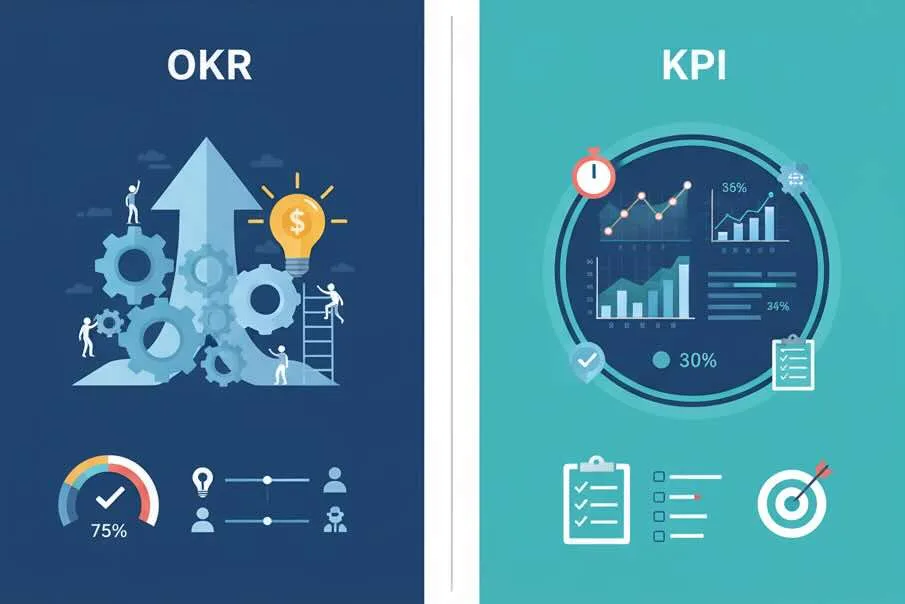
Differences Between Traditional Performance Management System and OKR

 OKR-BOK™ Certified Coach
Traditional performance management relies on annual reviews, fixed top-down targets, and goals that stay invisible across the organization. OKR operates on shorter cycles, makes goals visible to everyone, and allows teams to contribute to company direction from the bottom up. The structural gap between these two approaches shapes how organizations grow, adapt, and perform.
Traditional Performance Management System Approach
In Traditional Performance Systems, goals are set for annual periods. Budget and long-term strategies shape these goals at the beginning of the year. The set goals are seen as fixed and unchangeable commitments. The basis is the employee's adherence to the goals set throughout the year. This philosophy can work in slow-changing sectors. However, today's world is characterized by speed, uncertainty, and complexity. This is a weak point of the system. Goals are rarely revised during the year. Revisions do not occur unless major organizational changes necessitate them. Mid-year reviews conducted in the sixth month do not question the validity of the goals. They generally look at achievement rates. Consequently, the organization may spend resources for a year on goals that are not up-to-date. The year-end evaluation is entirely based on the percentage of goal achievement. This pushes the employee solely toward reaching the result. The employee's efforts in learning, innovation, and collaboration during the process take a back seat.
In traditional Performance Management Systems, annual targets are usually set at the beginning of the year and are closed at the end of the year according to the target realization rates, without being revised throughout the year.
Although some systems offer a 6-month interim evaluation; Instead of discussing these changing dynamics, conditions, needs and development process, meetings are held where the realization rates of the targets and the risks are discussed.
Revisions do not occur unless major organizational changes necessitate them.
Consequently, the organization may spend resources for a year on goals that are not up-to-date.
The year-end evaluation is entirely based on the percentage of goal achievement. This pushes the employee solely toward reaching the result. The employee's efforts in learning, innovation, and collaboration during the process take a back seat.
OKR (Objectives and Key Results) System
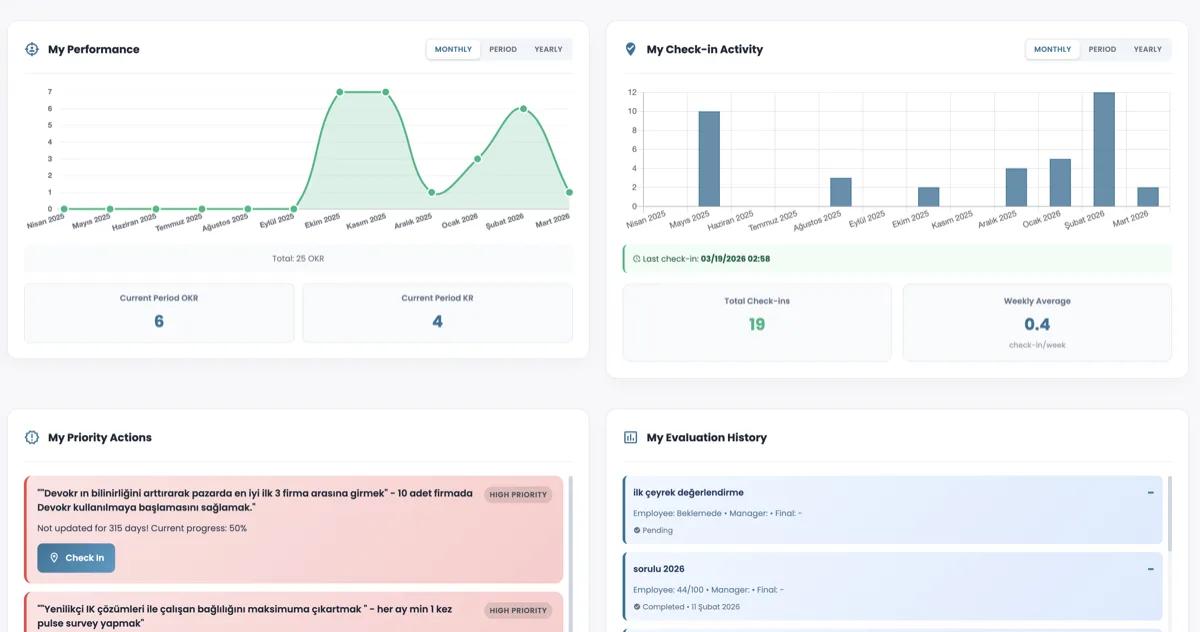
OKR adopts an agile management philosophy. This system works with short, agile cycles. Quarterly periods are mostly preferred. OKR allows for rapid adaptation to changing market conditions. Moves by new competitors or internal company learnings are immediately integrated into the goals. OKRs are evaluated at the end of each quarter. Updated and more ambitious goals are set for the next quarter. The organization constantly focuses on areas that create the highest value. Weekly or bi-weekly check-in meetings ensure that goals remain current. These meetings do not only discuss progress. They also address encountered obstacles, necessary resources, support needs, and development processes. The employee's journey and development toward the goal is centered, not the goal itself. It is necessary to go to these periodic meetings prepared. Employees should pay attention to the following points before attending the meetings:
The OKR System, on the other hand, ensures that goals are followed in an agile and dynamic way throughout the year. It allows targets to be revised and pursued as realistic and challenging goals, taking into account changing conditions, needs, internal and external dynamics.
In addition, thanks to the check-in meetings, which are usually held on quarterly basis, not only the realization rate of the goals, but also the support and development process that the employee needs in achieving the goal are discussed.
- Goals should be reviewed.
- Priorities from the previous check-in should be reviewed again.
- Progress recorded for the goals should be logged in the system.
- Data should be collected to prove progress and achievements.
- Encountered problems, factors slowing down the process, and difficulties should be identified.
- Ways to overcome these difficulties and solve the problems should be discussed.
- Anything requiring clarity regarding the goals should be noted.
- Suggestions, ideas, and temporary solutions for problems that need to be solved should be written down.
- Looking ahead, suggestions for the organization to achieve its goals should be planned.
In OKR, reaching 70%-80% of the goals can be considered a success. Contrary to the 100% expectation of the traditional system, the OKR system demands ambitious and challenging goals. Consistent 100% success indicates that the goals were not ambitious enough. This philosophy supports continuous growth and innovation.
Goal Creation Direction and Interaction
Traditional Performance Management Systems: Unidirectional Interaction
Goals are communicated top-down through a rigid cascading method. Top management first determines the strategic goals. These goals become the goals of the manager at the next level down. The manager then assigns these goals in pieces to the team members below them. This chain descends to the lowest level. In this method, the contribution of lower-level employees to goal setting is limited. The employee is a passive implementer who performs the task assigned to them. This situation reduces employee engagement. The alignment of goals with the real operational challenges at the lower levels can be questioned. Interaction occurs only in the direction of giving instructions.
The employee does not get the chance to align their goals with the Company goals and be part of the whole. Each employee focuses on the goals assigned to them, and full alignment does not occur, which makes it difficult to act within the framework of common goals and strategy for success.
OKR: Bi-directional Alignment
The OKR system uses a bi-directional interaction method, unlike traditional performance systems. Alignment is one of the fundamental building blocks of OKR. The Company's strategic OKRs draw a top-down direction. Bottom-up suggestions are received when Departmental and Individual OKRs are being determined. Employees personally set the most effective goals based on their own abilities.
In alignment with strategic priorities and Company OKRs, Top Management prepares and publishes their Objectives and Key Results (OKR). Employees create their draft OKRs in alignment with top management's goals. This work is also an individual preliminary preparation for the team OKR setting meeting. Employees who complete their individual OKR work and report to the same manager/project team meet to work on alignment and common Objectives and Key Results. After reviewing their individual work and all the Objectives and Key Results determined in the team OKR meeting, employees present their goal card to their manager.
Changes are made with the manager's guidance, and the employee goal card is finalized by consensus.
This participation strengthens employees' sense of being part of the team. Their commitment to the goals increases. Employees take on the role of solution partners, not just implementers. Bi-directional interaction supports a culture of trust and open communication within the organization.
Number of Goals and Focus
Traditional Performance Management System: Focus Fragmentation
Especially in large companies, an employee's annual goals can be numerous. These goals include personal development, process improvement, and operational goals.
Too many goals distract employees' attention. Resources are spread across multiple areas. This confirms the principle of "trying to do everything, doing nothing right." Employees generally focus on the easiest or most urgent goals. Challenging goals with the highest impact fall behind.
OKR: Limited and Critical Focus
The OKR system advocates for precise and limited focus. As a rule, an average of 4-5 Objectives is set. Limitation is made with a maximum of 4 Key Results for each Objective. This allows for prioritizing what is important and measuring it. Work is done and development is focused on goals that will move the Company and the employee forward and are prioritized, instead of daily routine work, repetitive operational tasks, or to-do lists.
In OKR, Objectives are qualitative. They should answer the question: What do I want to achieve? KRs, on the other hand, must be quantitative. They should answer the question: How will I know if I have reached the result? Measurable results are desired instead of a vague goal. For example, goals like "Increase Customer Satisfaction Score from 8.5 to 9.2" are set. This limitation ensures the organization focuses all its energy on the 3-5 most critical and strategic goals.
Goal Transparency and Culture
Transparency is the foundation of the OKR system. This approach is actually a cultural change for companies.
Traditional Performance Management System: Secrecy and Competition
Goals are confidential. No one sees the goals except the employee's manager and authorized Human Resources personnel. Employees do not know what other departments are focusing on.
This secrecy can create a competitive environment within the company. Silo structures between departments are strengthened. Information flow, collaboration, and a sense of common strategy are weakened. Employees find it difficult to see their goals' place in the organization's big picture.
OKR: Transparency and Collaboration
In OKR, transparency is a standard. All OKRs should be visible and trackable by everyone. Everyone, from the manager to the intern, sees the goals of others. Some sensitive goals may be hidden.
Transparency enables the creation of aligned goals that serve a common strategy. An employee clearly sees how their OKR supports their team's, department's, and company's OKR. This enriches teamwork and prevents resource conflicts. A culture of trust and accountability is established within the organization. Everyone learns from the successes of others, and process improvements are accelerated.
Feedback and Evaluation
Traditional Performance Management System: Annual Score Focus
It is based on an intensive year-end evaluation interview. This interview covers the entire year and results in a final performance score. The year-end interview addresses past events at a single point in time. Managers tend to remember the performance of the last few months rather than the performance at the beginning of the year. No updates or interim evaluations are made during the year. For this reason, goals set at the beginning of the year are calculated as planned, even if they have been subjected to changing conditions.
For example, production volume may vary according to demand. The production planned at the beginning of the year may change according to demand, changing market conditions, or machine downtimes. When these are ignored, the year-end achievements may not be satisfactory.
The score-focused system makes the main subject of the interview the "accuracy of the score." Important issues such as development, coaching, and career planning take a back seat.
OKR: Coaching and Continuous Communication
OKR encourages check-in meetings and a feedback culture. It prioritizes continuous communication and development. In OKR, feedback is instant and process-focused. Managers coach. Questions like "How can I support you to reach this goal?" or "Which obstacles can we remove?" are asked. The manager and employee are aligned on the same page throughout the year. There is no surprise situation at the end of the year.
The OKR philosophy advocates separating the goal achievement rate from salary and promotion decisions. This separation ensures that employees are not afraid to take risks, set ambitious goals, and learn from failure. If OKR is directly linked to compensation, employees will choose easy goals. The agile and challenging nature of the system is thus lost.
OKR System provides continuous communication and development with check-in meetings and feedback focus throughout the year. Thus, by the end of the year, the points that need improvement are discussed throughout the year, and the Manager and the Employee are aligned and agreed on the same page.
To sum up, The Traditional Performance Management System was useful for stable companies in the past. In today's rapidly changing market conditions, the system's annual cycle and rigid structure hinder agility. The OKR system, on the other hand, centers agility with quarterly reviews, focus with limited and challenging goals, alignment with bi-directional participation and transparency, and continuous development with check-ins and feedback. It transforms companies into a more dynamic, transparent, and people-centric structure.
OKR is not just a goal tool. It unites the entire organization around a common strategy. It coaches employees to reach their potential. This system is a cultural change tool.
This transformation shows that success does not only come from achieving goals. It also comes from continuous learning, collaboration, and the ability to adapt.
Frequently Asked Questions
What is traditional performance management?
In traditional performance management, goals are set annually, remain fixed throughout the year, and are evaluated at year-end based on achievement percentages. Goals cascade top-down through rigid hierarchy; employees are passive implementers. This approach worked in stable industries but struggles in today's fast-changing environment where annual cycles cannot keep pace with market shifts.
Why do annual reviews fall short?
Annual reviews address an entire year at a single point in time, and managers tend to remember only recent months. No updates occur during the year, so goals set in January are still scored in December even when market conditions changed completely. The score-focused structure pushes development, coaching, and career discussions into the background, creating surprise conversations instead of ongoing growth.
How does OKR differ from traditional systems?
OKR works in quarterly cycles that allow rapid adaptation to changing conditions. Goals are transparent and visible to everyone. Bidirectional alignment means employees contribute to goal setting rather than simply receiving targets. Regular check-in meetings address progress, blockers, and development continuously. A score of 0.7 is considered healthy, since consistent perfect scores signal goals are not ambitious enough.
Is OKR tied to salary and performance reviews?
OKR philosophy advocates separating goal achievement from salary and promotion decisions. When OKR is directly tied to compensation, employees choose easy targets to protect their bonus, and the stretch ambition that makes OKR powerful disappears. Google explicitly decouples OKR from compensation reviews. This separation is what allows teams to set genuinely ambitious goals without fear of financial consequences for falling short.
Can traditional companies adopt OKR?
Yes, but OKR is not just a tool change — it is a cultural transformation. Transparency, bidirectional alignment, and continuous communication become new norms. The transition works best when done gradually: start with a pilot in the leadership team, then expand to departments. Without genuine executive support, OKR cannot sustain itself. Leadership must visibly commit to the process for the rest of the organization to follow.
Start Using DevOKR Today, Free
Turn what you've read into action. Write your first OKR in minutes, free for small teams.