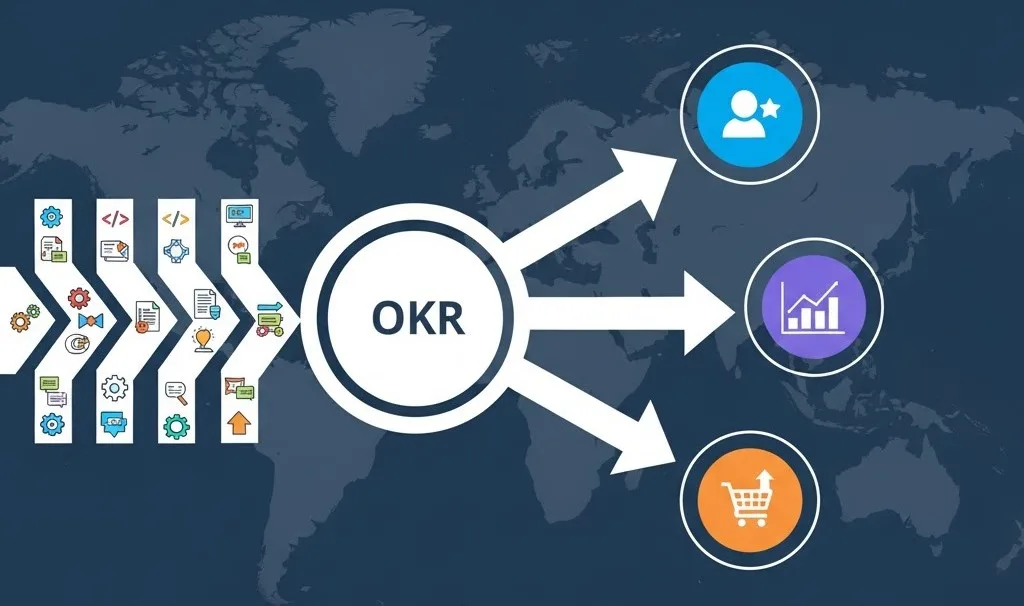
How OKR accelerates agile teams

Agile and OKR answer different questions. Agile defines how a team works: short cycles, continuous delivery, fast feedback. OKR defines what a team is working toward: the measurable outcomes a quarter of effort should produce. A sprint board can be green for three months while a product drifts away from what the business actually needs. OKR is what keeps velocity pointed at the right destination.
Agile teams are built for speed and adaptability—but without a clear strategic anchor, that speed can pull teams in competing directions. OKRs provide that anchor. By connecting quarterly goals to sprint-level execution, OKRs ensure that every iteration moves the team closer to outcomes that matter to the business, not just to the backlog.
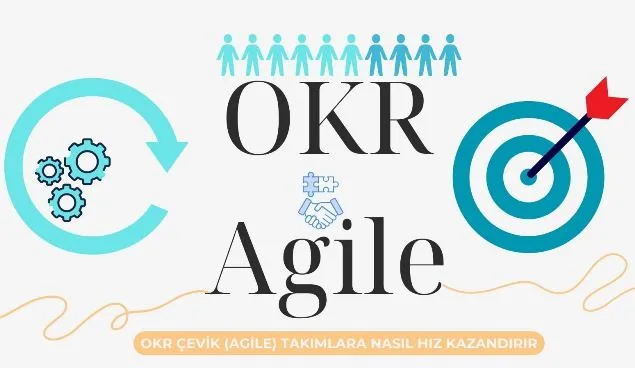
What OKRs Do for Agile Teams?
Enables Focus: Agile teams working in sprints focus on short-term tasks. OKRs align these short-term efforts with long-term company goals.
Enables Measurable Progress: Allows you to maintain controlled momentum with concrete metrics, thanks to key results.
Increases Motivation. When teams participate in the process of setting their own goals, ownership increases.
Provides Transparency. Keeping team members informed of all developments ensures a smoother process. Team feedback helps make rapid progress.
Ease of Adaptation: Quarterly OKRs allow you to quickly adapt to changing market conditions.
Weekly check-ins are the bridge between OKR strategy and agile execution. A 15-minute team sync covering "What did we progress on this week?" and "Are we still on track with the Key Result?" keeps OKRs alive during sprints instead of gathering dust until the quarterly review.
Each sprint goal should be framed as a step toward a Key Result. For example, if a Key Result is "Reduce checkout drop-off rate from 35% to 20%," the sprint goal becomes "Ship the simplified payment flow." This alignment eliminates the disconnect between product velocity and business impact—one of the most common failure points in agile organizations that adopt OKRs without integrating them into ceremonies.
What should we do to make OKR Agile?
Your OKR count should be maximum 4-5, maximum 4 key results is ideal for agile teams.
OKRs should complement the sprint goals, not conflict with them.
Progress should be flexible; if a key result becomes unattainable, you should immediately revise it with Agile.
Celebrate your success; this will boost your team's motivation.
In conclusion,
Agile teams can use OKRs as a "north star" to both maintain momentum and ensure progress in the right direction. After all, Agile asks "How will we do it?", while OKRs address "What do we want to achieve?". With the right integration, the Agile-OKR combination can deliver a noticeable leap in performance.
Finally, we can give examples of companies that are leaders in their sectors, such as Google, Netflix, LinkedIn, and Spotify, that combine these two methodologies in synergy.
Sprint Goals vs Quarterly OKR: How They Work Together
One of the most common misunderstandings in agile organizations is treating sprint goals and OKRs as interchangeable. They serve fundamentally different purposes. Sprint goals are tactical — they define what the team will deliver in the next one to four weeks. OKRs are strategic — they define the measurable outcomes the team wants to achieve over a quarter. A sprint goal might be "implement the new checkout flow." The corresponding OKR might be "Increase conversion rate from cart to purchase by 15%." The sprint delivers an output; the OKR tracks an outcome.
The relationship between sprints and OKRs should be hierarchical, not competitive. At the start of each sprint, the team asks: "Which Key Results will this sprint's work move forward?" This question prevents the common trap where agile teams become feature factories — shipping work at high velocity without knowing whether it produces real results. When every sprint is explicitly connected to a Key Result, the team builds a direct line of sight from daily work to quarterly strategy. The rhythm becomes: OKRs set direction → sprint planning selects the most valuable work → daily standups keep execution on track → sprint reviews evaluate both delivery and outcome progress.
Integrating OKR into Agile Ceremonies
The good news is that agile teams don't need to add new meetings to adopt OKR. The existing ceremony structure provides natural integration points. Sprint planning already asks "what are we working on?" — adding "and which Key Result does it serve?" takes thirty seconds but fundamentally changes the conversation. Sprint reviews already evaluate delivered work — adding a five-minute OKR progress update connects that work to strategic outcomes. Sprint retrospectives already ask "what can we improve?" — including OKR achievement data provides objective evidence for that discussion.
The most important integration point is the quarterly OKR planning session, which sits above the sprint cadence. This is where the product owner, scrum master, and team collectively decide the three to five outcomes that matter most for the next 90 days. This session replaces the vague "roadmap alignment" meetings that many agile teams suffer through. Instead of debating features, the team debates outcomes — and then uses their sprint cadence to experiment, iterate, and discover the best way to achieve those outcomes.
bi-weekly OKR check-in (which can replace or supplement an existing meeting) keeps strategy visible between quarters. The format is simple: for each Key Result, the team reports the current score, the confidence level, and any blockers. This takes fifteen minutes and prevents the common failure mode where teams set OKRs in January and don't look at them again until March. Consistency matters more than ceremony, a brief, regular check-in outperforms an elaborate quarterly review every time.
Anti-Patterns: When Agile + OKR Goes Wrong
Using OKRs as a sprint backlog: When Key Results become task lists ("Complete 12 user stories," "Deploy 3 microservices"), the team is doing project management, not goal setting. Key Results should measure outcomes, not outputs. A better Key Result: "Reduce average API response time from 800ms to 200ms."
Setting OKRs that never change: Agile is built on learning and adaptation. If a Key Result becomes irrelevant mid-quarter because the team discovered new information, clinging to it isn't disciplined — it's wasteful. The team should document the pivot, adjust the Key Result, and move forward.
Ignoring OKRs during sprint planning: If the sprint backlog is entirely driven by stakeholder requests and bug reports with no connection to OKRs, the team is reactive, not strategic. At least one significant sprint item should map to a Key Result each sprint.
Conflating velocity with OKR success: High velocity means the team ships fast. High OKR achievement means the team ships the right things. These are not the same. A team can complete every story point on schedule and still miss their Key Results if the work wasn't pointed at the right outcomes.
Practical Example: Agile Product Team OKR
Here's how an agile product team might structure their quarterly OKR and connect it to their sprint cadence:
Objective: Deliver a seamless onboarding experience that converts trial users into paying customers.
- Key Result 1: Increase trial-to-paid conversion rate from 8% to 14%.
- Key Result 2: Reduce average time-to-first-value from 3 days to 1 day.
- Key Result 3: Achieve NPS score of 50+ from users who completed onboarding.
Sprint 1 focus: Redesign the onboarding wizard based on user research findings. Sprint 2 focus: A/B test two onboarding flows and measure conversion impact. Sprint 3 focus: Implement the winning flow and optimize based on data. Each sprint has a clear deliverable, and each deliverable connects to a measurable Key Result. At the bi-weekly check-in, the team updates KR scores and adjusts the next sprint's priorities based on what they've learned.
Scaling OKR in Large Agile Organizations
In small agile teams, OKR integration is straightforward — one team, one set of OKRs, one sprint cadence. In larger organizations running SAFe, LeSS, or Nexus, the coordination challenge multiplies. Multiple agile teams working on the same product need shared OKRs at the program level, while maintaining team-level OKRs for autonomy. The quarterly Program Increment (PI) planning in SAFe naturally aligns with OKR quarterly cycles, making it a logical integration point.
The key principle for scaling is: OKRs align, sprints execute. Company-level OKRs set the strategic context. Team-level OKRs define each team's contribution to that strategy. Sprint planning determines the fastest path to achieve those OKRs. This layered approach prevents the two failure modes of scaled agile: teams that are perfectly autonomous but strategically disconnected, and teams that are perfectly aligned but have no room to experiment and adapt. OKR provides the alignment; agile provides the execution flexibility.
Frequently Asked Questions
How does OKR work with Agile?
Agile defines how a team works — short cycles, fast feedback, continuous delivery. OKR defines what that work should achieve. A sprint board can stay green while the product drifts from business goals. OKR sets quarterly direction so every sprint connects to outcomes that matter, not just to the backlog.
How do OKRs fit into Scrum sprints?
Each sprint goal should map to a Key Result. During sprint planning, simply ask: 'Which Key Result does this work advance?' No new meetings are needed — integrating OKR into existing ceremonies takes 30 seconds at sprint planning and 5 minutes in sprint reviews for a progress update.
What is the difference between OKR and Agile goals?
Agile sprint goals focus on near-term deliverables, typically within a few weeks. OKRs operate at a higher level, targeting quarterly measurable outcomes. A sprint answers 'what will we ship next?' while an OKR answers 'what business result should that shipment drive?' One produces work items, the other tracks whether that work created real impact.
Can Kanban teams use OKR?
Yes. Because Kanban is not tied to fixed sprints, OKR integration is actually more flexible. Quarterly OKRs add strategic context to the flow. During weekly check-ins, tracking which work items contribute to each Key Result ensures the team stays strategically focused even as the Kanban board runs smoothly.
How do OKRs help Agile teams stay focused?
The most common trap for agile teams is becoming a feature factory — shipping fast without knowing if the work produces real business outcomes. OKR prevents this by making quarterly priorities explicit. With a maximum of 4-5 Key Results, teams can clearly see which sprint work matters most and which requests can wait.
Start Using DevOKR Today, Free
Turn what you've read into action. Write your first OKR in minutes, free for small teams.