OKR vs KPI vs MBO: Differences and How They Work Together

 OKR-BOK™ Certified Coach
A company can hit every KPI and still miss its strategic goals. KPIs measure how well you are running today's operations. OKR measures whether you are moving toward where you need to be. That single distinction changes how leadership should read a dashboard, and whether the numbers on it signal health or stagnation.
OKR (Objectives and Key Results), KPI (Key Performance Indicators), and MBO (Management by Objectives) are three frameworks that are often discussed together. Each involves measurement and goals, but their functions, scopes, and value to the organization differ. They are not interchangeable, and choosing the right tool for the right purpose matters more than picking a winner.
The main distinction is OKR's focus on alignment. OKR aligns the organization's goals with the employees' individual goals. KPI focuses on measuring the performance of specific organizational aspects. Instead of using one over the other, companies should leverage their complementary strengths. This ensures the right balance between agility and stability.
What is OKR?
OKR is the abbreviation of Objectives and Key Results. It sets an organization's objectives. It also tracks the goals. It is a new management tool used for alignment. It has a philosophy different from traditional goal-setting methods. It creates a clear fit between company goals and employee goals. Transparency and measurability are core elements.
OKR is not just a list of goals. It is also an important tool for cultural change. It starts from the organization's highest vision. It defines what everyone must focus on, down to the lowest unit. The results of this focus are measured in a systematic structure.

Objectives
Objectives are high-level aims the organization wants to achieve.
They provide a qualitative answer to the question: "What do we want to achieve?"
Characteristics:
- Must be inspiring and motivate employees.
- Must be short and memorable.
- Usually limited to a quarterly period.
Key Results (KR)
Key Results are criteria that show whether the objective has been met. These are specific, measurable outcomes. They ensure the goal turns into tangible progress tracking.
They provide a quantitative answer to the question: "How do we measure reaching the goal?"
Characteristics:
- Must include a number, percentage, or score. Must be quantitative and measurable.
- Must be at a challenging level.
- Should measure the result created by the activity, not just the work done.
KR is a metric that shows progress. A task is the action taken to reach this metric.
OKR's Core Philosophy:
OKR defines where you want to be. It does not define where you are right now. This framework provides the direction the organization should take. It gives the necessary strategy and the adopted context.
What is KPI?
KPI, the abbreviation of Key Performance Indicator, is a tool. It allows measuring and tracking metrics that are important to your institution. KPIs can be very useful for measurement. They are an effective numerical indicator of what is going well or badly. However, they are independent. They do not determine the company's development strategy or direction.
For example, website click-through rate is a KPI. Social media follower count or customer complaint rate are also KPIs.

Below are typical KPIs across three core B2B SaaS functions, with the ranges most teams aim for. Treat these as benchmarks, not absolute targets.
| Function | KPI | Typical Range |
|---|---|---|
| Marketing | Visitor-to-Lead Conversion | 5-10% |
| Cost per Lead | $40-80 | |
| Organic Traffic Growth (QoQ) | 5-15% | |
| Sales | Win Rate (mid-market) | 20-30% |
| Time to Close | 30-60 days | |
| Average Deal Size (mid-market) | $5K-25K | |
| Customer Success | CSAT Score | 90-95%+ |
| Time to First Value | 2-7 days | |
| Net Revenue Retention | 100-115% |
KPI's Core Philosophy:
KPIs are used to check and monitor an organization's current operational status. These metrics are independent. They alone do not determine the company's direction, development strategy, or orientation. KPIs are generally like checklist items. They are tracked daily or weekly to see if a goal has been successfully met.
What is MBO?
MBO stands for Management by Objectives, the framework Peter Drucker introduced in 1954. It is the original goal-setting system that most modern frameworks, including OKRs, trace back to. Its purpose is to align each employee's work with the company's annual strategic objectives by translating top-level goals into personal targets that the manager and the employee agree on together.
MBO follows an annual top-down rhythm. Senior leadership sets the year's strategic objectives, and each layer below cascades its own targets downward until every employee has a personal goal set tied to the corporate plan. Targets are typically written to be realistic and fully achievable, often using SMART criteria. Year-end performance against those targets is reviewed by the manager and feeds the bonus, raise, or promotion decision.
MBO's Core Philosophy:
MBO ties strategy, performance, and pay into a single annual loop. It works best in stable environments like large traditional enterprises and manufacturing, where the year ahead is reasonably forecastable. Where conditions change faster, OKRs replaced it as the modern alternative.
OKR vs KPI vs MBO: Key Differences
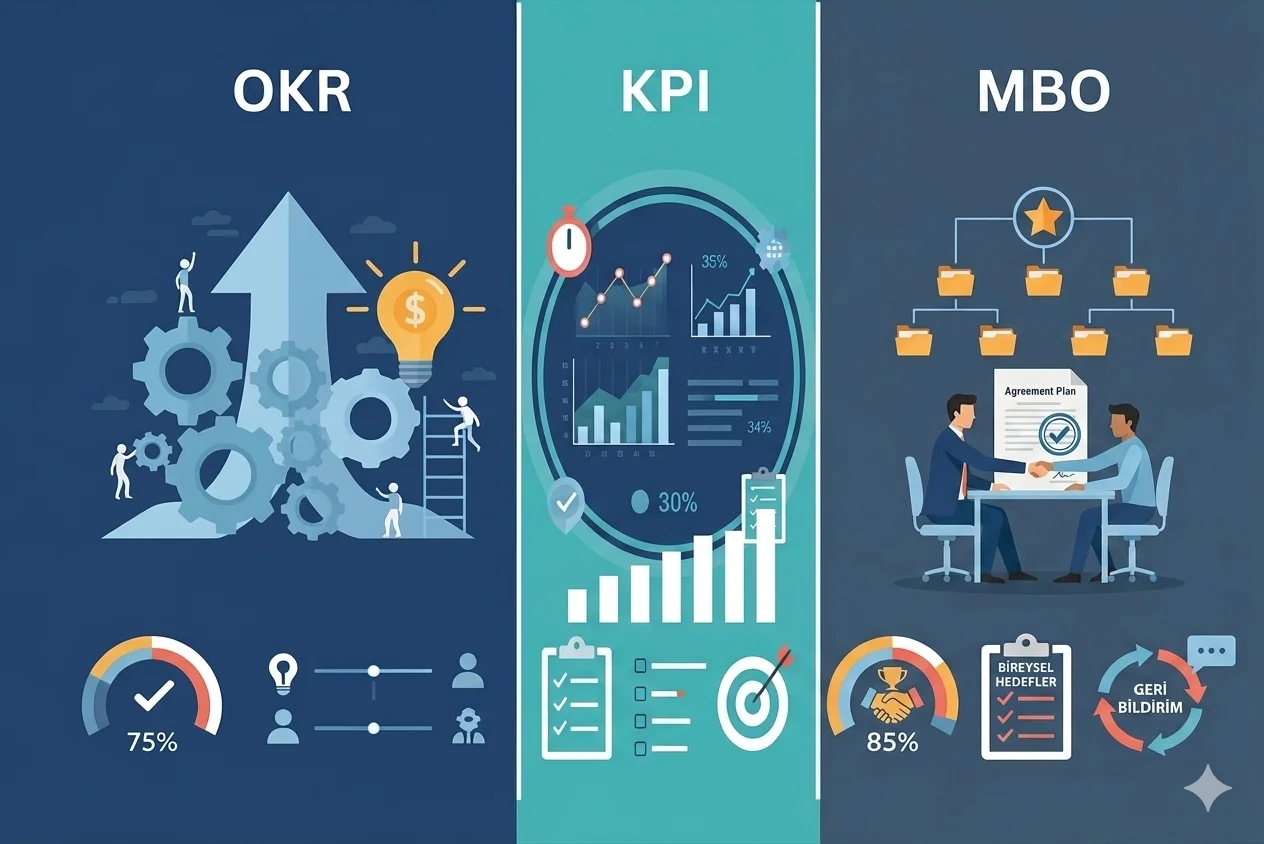
OKR drives transformation, KPI tracks operational health, and MBO sets annual direction. Each one is built around a different question, which is why they look similar on the surface but behave very differently in practice.
OKR is often mentioned alongside KPI and MBO, but each serves a fundamentally different purpose. The table below clarifies where they overlap and where they diverge.
| OKR | KPI | MBO | |
|---|---|---|---|
| Purpose | Drive change and stretch | Monitor ongoing health | Evaluate individual performance |
| Typical Cycle | Quarterly | Continuous / always-on | Annual |
| Success Threshold | 60-70% is healthy | 100% target expected | 100% tied to bonus |
| Goal Direction | Bidirectional (60/40) | Defined by management | Top-down |
| Mid-cycle Changes | Encouraged when context shifts | Thresholds rarely change | Locked until annual review |
| Ambition Level | Stretch goals encouraged | Realistic targets | Conservative (pay-linked) |
How OKR, KPI, and MBO Differ in Practice
Focus: OKR prioritizes what is important. It directs energy to the most critical 3-5 areas. KPI, in contrast, can be used to track hundreds of different business processes. OKR prioritizes only what is critical. KPI monitors everything that is important. MBO sits in the middle: each employee carries a small set of personal objectives, but the focus is on annual completion rather than quarterly prioritization.
Aspiration: OKRs are challenging. They push employees outside their comfort zones. KPIs are generally protective. They aim not to fall below a determined standard or threshold. MBO targets are conservative by design, because missing them affects the employee's bonus or rating.
Progress vs. Status: OKR manages the process of moving the organization from point A to point B. KPI monitors the current status of the data as the organization moves to point B. MBO checks at year-end whether the agreed point B was reached, with little visibility along the way.
KPI is like the fuel gauge in a car. It shows the current status. OKR is the navigation system pointing toward a new destination. MBO is the annual road map you draw at the start of the year and stick to.
How Can OKR and KPI Be Used Together?
How Do KPIs Feed OKRs?
KPIs serve as the core metrics in performance measurement. OKRs are the most important milestones of the company's future success.
Determining Current Status: An organization looks at its current critical KPIs before starting to set OKRs. For example, if the customer satisfaction KPI is low, this signals a need for change.
Converting the Need for Change into an OKR: The low KPI provides data to form the OKR.
- KPI Status: Current satisfaction rate. For example: 30%.
- OKR Objective: To Become the Sector Leader in Customer Satisfaction.
- OKR Key Result (KR): To increase the customer satisfaction rate from 30% to 50%.
In this example, the Customer Satisfaction metric is a KPI. However, changing this metric by a certain rate (raising it from 30% to 50%) becomes an OKR Key Result.
Can KRs Be KPIs?
Yes. OKR Key Results use a KPI definition because they are the numerical data being tracked.
Example Explanation:
- Objective: To increase the company's brand awareness.
- KR 1: Increase website click-through rate by 30%.
- KR 2: Increase the number of followers on the Instagram page to 1 million.
The metrics that are key to reaching this objective (follower count, click-through rate) are actually KPIs. This numerical data must be tracked. Follower count and click-through rate are defined as KPIs in this context. The difference of the KR is not just tracking the number. It is connecting it to a challenging goal and measuring the progress.
From KPI to OKR: Two Transformations
The clearest way to see how OKRs build on KPIs is to watch the same metric move from one to the other. Both examples below start with a KPI that has stalled and reframe it as an OKR with the ambition to actually move it.
A team had been tracking "Week-1 Activation Rate" for six months, stuck at 42% against a 50% threshold. The KPI was being monitored, not transformed. Reframed as an OKR:
Make the first week so valuable customers can't imagine going back
- KR1Lift week-1 activation from 42% to 65%
- KR2Reduce time-to-first-value from 5 days to 2 days
- KR3Raise week-1 NPS from 28 to 45
The KPI threshold (50%) now becomes the baseline; the OKR aims to push it to 65%. It is challenging, but designed to drive progress rather than just track it.
Same mechanics, different domain. MQL-to-SQL conversion stuck at 18% against a 25% target for nine months. Reframed:
Build a qualification process buyers thank us for
- KR1Raise MQL-to-SQL from 18% to 32%
- KR2Cut sales cycle from 45 to 30 days
- KR3Achieve 80%+ post-discovery satisfaction
The 25% target remains as the operational baseline; the OKR target is intentionally ambitious, and reaching around 70% of it would already indicate strong progress and success.
Why Both Belong in the Same System
The goal of using both is not balance for the sake of balance. KPIs protect what matters today; OKRs transform what needs to change for tomorrow. Skip the first and you lose stability; skip the second and progress stalls.
Scope of Application and Tracking Frequency
| Feature | OKR (Objectives and Key Results) | KPI (Key Performance Indicators) |
|---|---|---|
| Time Frame | Quarterly cycles. Linked to annual strategic goals. | Continuous tracking (Daily, weekly, monthly). |
| Accountability | Teams and leaders responsible for strategic growth and change. | Everyone managing operational processes and maintaining standards. |
| Area of Use | Growth projects such as new product development, market entry, and radical process improvement. | Routine operations such as customer service wait time, server uptime, and sales conversion rate. |
| Context | Tells the story behind the goal and its strategic importance. | Shows the number and status behind the goal. |
OKR and MBO: When to Replace, When to Coexist
OKR and MBO live in the same conceptual space: both are about agreeing objectives, then measuring against them. KPI sits next to OKR because it does a different job; MBO and OKR compete for the same job. That makes their relationship simpler in one sense (you usually pick one) and more nuanced in another (sometimes both have a role to play).
When OKR Replaces MBO Entirely
This is the most common path. When the year ahead is no longer predictable, when annual targets get stale by Q2, or when teams need to course-correct between formal reviews, MBO's annual cadence becomes a liability. Companies in fast-moving tech, growth-stage startups, and modernizing enterprises typically retire MBO altogether: quarterly OKRs replace the annual cycle, scoring is unbundled from compensation, and Key Results take over from individual annual targets. The performance review still happens, but it draws on observed behavior and outcomes, not OKR scores.
When the Two Coexist
Some organizations cannot or do not want to abandon MBO. Regulated industries, large enterprises with bonus structures tied to annual targets, or companies whose HR processes assume an annual review cycle often keep MBO in place for compensation and accountability. In that case, OKRs run as a parallel layer focused on strategic transformation: MBO remains the formal record for pay and reviews, while OKRs at the team or initiative level drive the change agenda. The two stay separated by purpose. Mixing them, especially tying OKR scores to bonuses, collapses both back into MBO.
How to Migrate Without Disruption
A clean migration usually takes one full year. Start with one team or department piloting OKRs for a quarter while the rest of the company stays on MBO; this builds credibility and surfaces cultural friction early. In the next quarter, expand to a few more teams and split OKR scoring fully away from bonus discussions. By Q3, move every team to quarterly OKRs and treat the year-end MBO review as the last formal annual cycle. From the following year, OKRs carry the strategy, and the annual review becomes a development conversation rather than a target verdict.
Common Mistakes When Combining OKR with KPI and MBO
The mistakes below are specific to running OKRs alongside KPIs and MBO. Each one comes from confusing what each framework is for: KPIs maintain, MBO formalizes annual accountability, and OKRs transform. Mixing their habits creates the worst of all three.
1. Writing KPIs as stretch targets
KPIs are the realistic thresholds you defend, not ambitious targets you struggle to reach. A KPI like "Maintain 99% uptime" is a defensible threshold; writing it as "Increase uptime to 99.99% next quarter" turns it into an OKR. The former is a health metric; the latter is transformation. If a number deserves to be stretched, it belongs in an OKR, not on a KPI dashboard.
2. Treating OKRs as monitoring dashboards
OKRs are quarterly transformation tools, not weekly status reports. When a team opens its OKR sheet just to "see where things are," the framework loses its purpose. Use KPIs for monitoring; use OKRs to drive a specific change you committed to ninety days ago.
3. Setting Key Results with KPI thresholds (100% expectation)
OKR Key Results are healthy at 60-70% achievement; that band is what makes stretch goals possible. Treating a KR as a 100% target collapses the difference between a KPI and an OKR. Teams stop reaching, because reaching means risking a "miss."
4. Tracking KPIs but Converting None into OKRs
If there is a wall full of healthy-looking KPIs and no OKRs anywhere, it means the team is operationally sound but strategically stuck. KPIs alone do not move a company forward; at any given time, at least one should serve as the seed of an active OKR.
5. Treating OKRs as annual MBOs
Running OKRs on an annual cycle is the most common MBO leftover. The whole point of OKRs is the ninety-day feedback loop: set, learn, adjust. When teams plan once a year and revisit at year-end, they lose the agility OKRs were built for and end up with MBO in OKR clothing. If your business genuinely needs annual planning, MBO is the more honest choice.
6. Tying OKR scores directly to compensation
In MBO, hitting 100% of your annual objectives drives your bonus or promotion. Carrying that mindset into OKRs collapses the framework: when pay depends on the score, employees set targets they know they can hit, ambition disappears, and the 60-70% stretch zone vanishes. OKR scores should inform development conversations, not compensation decisions. Keep the two systems separated, the way Andy Grove originally designed it.
OKR, KPI, and MBO each address a different need in modern management. Where MBO sets long-term direction with annual rigidity, OKR drives quarterly transformation, and KPI maintains operational health. The three together cover strategy, change, and stability.
OKRs are an organization's compass. They show where it is going and what major moves it needs to make to get there. OKR encourages the organization toward development and change. KPIs are the organization's dashboard. They continuously monitor its current health, stability, and whether critical processes are functioning according to standards. KPI encourages the organization to be stable and reliable.
A successful organization uses KPIs to maintain its stability. It uses OKRs to build its future. Organizations should protect their core elements through KPIs. They should pursue aggressive growth and strategic change goals through OKRs. The right combination of both tools enables the company to be both agile and resilient.
Frequently Asked Questions
What is the difference between OKR and KPI?
OKR defines where the organization needs to go; KPI shows how current operations are performing. OKR drives strategic transformation through quarterly cycles with ambitious goals. KPI tracks operational metrics monitored daily or weekly. The two are not competitors. They are complementary tools that work best together.
Can KPIs be used as Key Results?
Yes. OKR Key Results technically use KPI definitions because they are numerical data being tracked. The difference is that a KPI is simply monitored, whereas a Key Result connects that metric to an ambitious target and measures progress toward it. A website click-through rate is a KPI; committing to increase it by a specific percentage makes it a Key Result.
Should companies choose OKR or KPI?
Companies should use both. KPIs are necessary for monitoring core processes and remain part of daily operational routines. OKRs focus on the metrics you want to transform significantly. Successful organizations use KPIs to maintain stability and OKRs to build their future. Choosing one over the other misses the complementary strength of each.
How do OKR and KPI work together?
KPIs reveal the current state and feed into OKR planning. If a customer satisfaction KPI is low, it signals a need for change and can become an OKR Objective. OKRs then manage that transformation, while KPIs continue monitoring the current state throughout the process. KPIs diagnose the problem; OKRs prescribe the direction.
Do OKRs replace KPIs?
No. OKRs do not replace KPIs. KPIs are the organization's dashboard; they continuously monitor whether critical processes meet standards. OKRs are the compass; they show where the organization needs to go. A successful organization needs both: KPIs ensure stability and OKRs drive progress toward strategic transformation.
What is the main difference between MBO and OKR?
MBO sets annual objectives that managers and employees agree on, then reviews them at year-end against the bonus or promotion. OKR breaks the year into quarterly cycles, separates scoring from compensation, and adds measurable Key Results that focus on outcomes rather than activity. In short: MBO is built for stable annual planning tied to performance reviews, while OKR is built for quarterly transformation in fast-moving environments.
Can MBO and OKR coexist in the same company?
Yes, but they need clear boundaries. Many large organizations keep MBO for annual individual performance reviews tied to compensation, while running OKRs in parallel for quarterly strategic transformation. OKR scores work best when kept separate from compensation and the formal year-end review; mixing them tends to collapse OKRs into MBO and erode the stretch zone. If you adopt both, treat MBO as the formal accountability layer and OKR as the change layer.
Start Using DevOKR Today, Free
Turn what you've read into action. Write your first OKR in minutes, free for small teams.