9-Box Grid: A Practical Guide to Talent Reviews and Calibration

 OKR-BOK™ Certified Coach
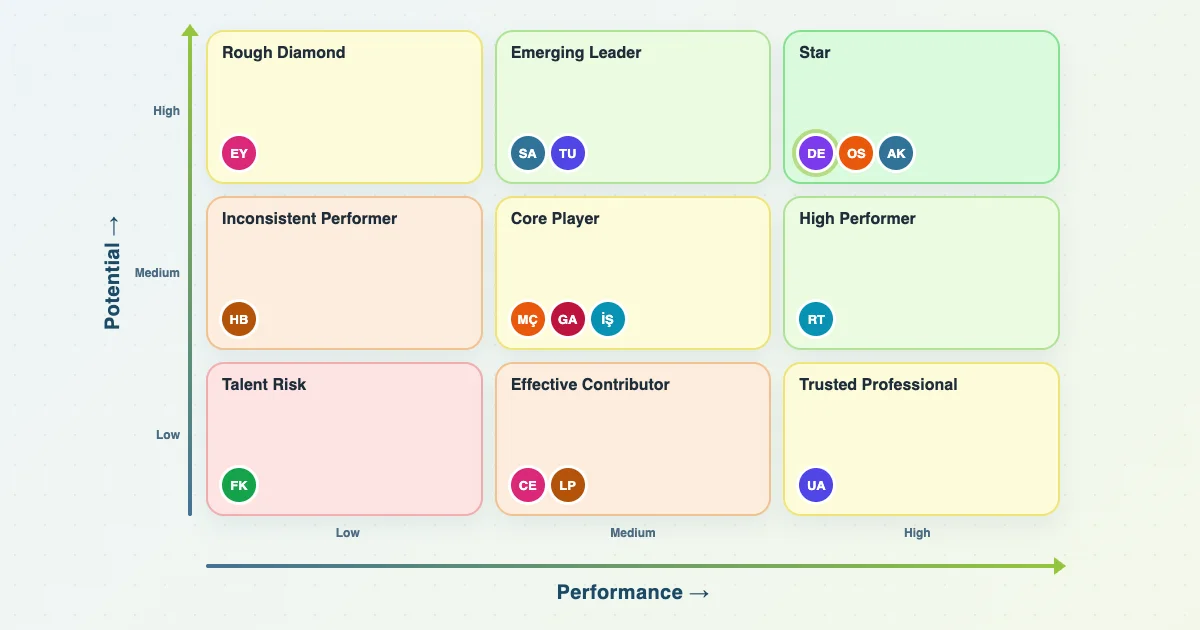
The 9-box grid places each employee on two axes, current performance and future potential, each split into low, medium and high. The result is a three-by-three map of your talent that helps leaders decide who to develop, who to stretch and where the organization is thin.
The grid itself is simple. The hard part is everything around it: what counts as evidence on each axis, how managers agree on placements, and how to stop the exercise from turning subjective judgments into permanent labels. This guide covers all three.
What is the 9-box grid?
A 9-box grid is a talent review tool. The horizontal axis usually shows performance: how well someone delivered in their current role over the review period. The vertical axis usually shows potential: how far and how fast they could grow into broader or more senior roles. Each axis has three bands, so every employee lands in one of nine boxes.
The format borrows from portfolio planning. McKinsey describes the original nine-box matrix as a tool that arose in the early 1970s to compare business units on industry attractiveness and competitive strength.[1] Organizations later applied the same three-by-three logic to people, and it has since become a familiar format for talent reviews and succession discussions.
Two things make the 9-box useful. It forces a distinction between what someone has done and what they might do next, and it gives a group of managers a shared picture to discuss. Both only work if the inputs are honest, which is where most implementations struggle.
The two axes: performance and potential
Most problems with the 9-box start with the axes. If performance and potential are defined loosely, managers fill both with the same overall impression and the grid collapses into a diagonal line from bottom left to top right.
Performance: what the person delivered
Performance is the easier axis because it looks backward and can rest on evidence. Strong inputs include goal outcomes such as OKR scores, results against role expectations and the structured ratings from the year-end review. Use the same review period for everyone on the grid, and decide in advance which sources count and how they combine.
Potential: potential for what?
Potential is harder because it is a forecast. In their review of how organizations identify high potentials, Silzer and Church found little agreement within or between organizations on what the concept actually means.[2]
The practical fix is to define potential against a destination. Potential for a larger role in the same function, potential for people leadership and potential for a senior general management role are different questions, and the same person can score differently on each. Write the definition down before the review and make every manager use it.
Keep the two axes apart
The most common error is letting performance leak into potential. A strong performer is easy to label high potential, and a newcomer who has not had time to deliver is easy to underrate. Dries and Pepermans name this confound between performance and potential as one of the typical issues that undermine assessments of leadership potential.[3]
A simple guard is to agree on different evidence for each axis:
| Axis | Stronger evidence | Weaker evidence |
|---|---|---|
| Performance | Goal outcomes, review ratings for the period, measurable results against role expectations | General impressions, visibility to senior leaders, the last few weeks only |
| Potential | Learning speed in new situations, behavior in stretch assignments, 360° feedback on leadership behaviors, stated career aspirations | Current performance alone, tenure, similarity to current leaders |
The nine boxes, one by one
There is no standard set of box names. Different sources call the top right box Star, Future Leader or Exceptional Talent, and some even swap the axes. What matters is that everyone in your organization uses the same labels with the same meaning. The names below are common examples, with what each box usually signals and a typical next step.
High potential, not yet delivering. Often new to the role or in the wrong one.
Next step: Check fit and onboarding, set clear short-term goals.
Growing fast, delivery still uneven.
Next step: Stretch assignments with close coaching.
Delivers now and could take on much more.
Next step: Plan the next move and a retention conversation.
Below expectations with some growth signals.
Next step: Find the cause before judging the person.
Reliable contributor with steady growth.
Next step: Develop in role and widen the scope gradually.
Strong results, moderate room to move up.
Next step: Recognize, deepen expertise, consider lateral moves.
Below expectations, few growth signals.
Next step: Agree on a performance plan with a clear timeline.
Meets expectations in a stable role.
Next step: Keep engaged and focus on mastery of the role.
Excellent in role, suited to depth more than upward moves.
Next step: Reward expertise and watch the workload.
Treat each box as the start of a conversation, not a verdict. Placements change from one review to the next, and a box that follows someone for years without fresh evidence does more harm than good.
How to run a 9-box talent review
A talent review has two parts: placing people on the grid and agreeing on what the placements mean. The steps below keep both grounded in evidence.
- Define the axes and the evidenceWrite down what performance and potential mean for this review, which sources feed each axis and how scores map to the three bands.
- Pre-place people from dataStart from the scores rather than from a blank grid. When placements come from review data, the meeting discusses exceptions instead of rebuilding every rating from memory.
- Calibrate as a groupManagers review the grid together, challenge placements that look out of line and move people only with a stated reason.
- Decide an action for every boxEvery placement leads to a next step: a stretch assignment, a development plan, a retention conversation or a performance plan.
- Follow up next cycleCompare this year's placements with last year's. Movement over time tells you more than any single grid.
Running the calibration meeting
Calibration is where the grid earns or loses its credibility, and the research on calibration committees is encouraging but not unconditional. In a study of a large multinational, committees adjusted about a quarter of initial ratings, mostly downward. They made ratings more consistent across supervisors and reduced leniency, but they also pushed ratings toward the middle of the scale.[4]
Calibration can also change how managers rate in the first place. In a professional services firm, the calibration committee disciplined supervisors who strategically inflated their teams' ratings, and that behavior was reflected in the supervisors' own ratings and promotions.[5]
A few practices make the meeting work:
- Send the pre-placed grid and the evidence behind it before the meeting, so the time goes to discussion rather than reading.
- Ask for evidence with every move: a result, an example or a pattern, not an impression.
- Use a facilitator who does not manage anyone on the grid and who watches for one voice dominating.
- Look at the distribution at the end. If almost everyone sits in the middle box, the group may be avoiding hard calls.
- Record each decision and its reason, so next year's review starts from what was agreed.
Try it below: drag a card to another box and watch the distribution and the decision log update while the review score stays the same.
Drag a card and drop it into another box
This is how 9-box calibration in Devokr works: people start in the box their review scores point to, managers move them by drag-and-drop, and every move is recorded while the review score itself stays unchanged. In Devokr the grid is called a talent map, and you name the boxes yourself.
Where the 9-box goes wrong
The 9-box is only as fair as the judgments that feed it, and the potential axis carries the most risk.
Bias in potential ratings
The clearest evidence comes from a study of 29,809 management-track employees at a large retail chain that used a Nine Box grid. Women received substantially lower potential ratings despite receiving higher performance ratings, the difference accounted for about half of the gender promotion gap, and women went on to outperform their male colleagues.[6]
The lesson is not to drop potential ratings but to treat them as the part of the grid that needs the most scrutiny: define them, ask for evidence and check the distribution across groups during calibration.
Boxes that turn into labels
A box assigned once can follow a person for years. People in the lower boxes may get fewer chances to prove themselves, which then makes the original placement look right. Revisit every placement each cycle and keep the reasons, so a box reflects current evidence rather than history.
Everyone in the middle
Calibration reduces leniency but can increase centrality, as the multinational study above showed. A grid where most people sit in the center box hides the differences the exercise was meant to reveal. Ask managers to justify middle placements as carefully as extreme ones.[4]
The 9-box and succession planning
The 9-box is often the first input to succession planning, but potential is not the same as readiness. Someone can have high potential for a senior role and still need two years of development before they are ready to step into it.
Keeping readiness as a separate judgment and tracking it over time turns the grid into a working plan. That is where succession planning with OKRs helps: readiness becomes a quarterly goal with measurable progress instead of a name on a chart.
Used well, the 9-box is less a rating tool than a structured conversation. It works when the axes are defined before anyone is placed, when placements start from evidence and when the people calibrating them are willing to challenge each other.
It also works best as part of a rhythm rather than a once-a-year ritual. Regular feedback conversations between reviews give managers the evidence the grid needs and give employees a clearer picture of where they stand.
Frequently Asked Questions
What is a 9-box grid used for?
A 9-box grid is used in talent reviews and succession planning. It places employees in one of nine boxes based on performance and potential, so leaders can decide together who to develop, who to stretch and which roles lack ready successors, using one shared picture instead of separate opinions.
What do the two axes of the 9-box grid mean?
The horizontal axis usually shows performance: what the person delivered in their current role during the review period. The vertical axis shows potential: how far they could grow into broader or more senior roles. Defining potential against a target role and using different evidence for each axis keeps the two from blurring together.
How do you run a 9-box calibration meeting?
Pre-place people from their review scores and share the grid with its evidence before the meeting. In the meeting, managers review placements together, ask for evidence behind every move and record each decision with its reason. A neutral facilitator and a distribution check at the end help stop everyone from drifting into the middle box.
What are the main weaknesses of the 9-box grid?
The biggest risk sits on the potential axis, because potential is a forecast. Research shows potential ratings can carry bias, for example women receiving lower potential ratings despite higher performance ratings. Boxes can also harden into permanent labels, and calibration can push ratings toward the middle. Clear definitions and a fresh review every cycle reduce these risks.
How often should the 9-box grid be updated?
At least once per review cycle, usually after the year-end review. What matters is not a single grid but how placements change over time. Comparing this year's placements with last year's shows who is moving up and who needs support far better than any one snapshot.
Sources
- ↑ McKinsey Quarterly, Enduring ideas: The GE–McKinsey nine-box matrix (2008)
- ↑ Silzer & Church, Industrial and Organizational Psychology, The Pearls and Perils of Identifying Potential (2009)
- ↑ Dries & Pepermans, Human Resource Management, How to identify leadership potential: Development and testing of a consensus model (2012)
- a b Demeré, Sedatole & Woods, Management Science, The Role of Calibration Committees in Subjective Performance Evaluation Systems (2019)
- ↑ Grabner, Künneke & Moers, The Accounting Review, How Calibration Committees Can Mitigate Performance Evaluation Bias: An Analysis of Implicit Incentives (2020)
- ↑ Benson, Li & Shue, American Economic Review, “Potential” and the Gender Promotion Gap (2026)
Start Using DevOKR Today, Free
Turn what you've read into action. Write your first OKR in minutes, free for small teams.