Intrinsic Motivation: What Actually Drives People (and What Quietly Kills It)

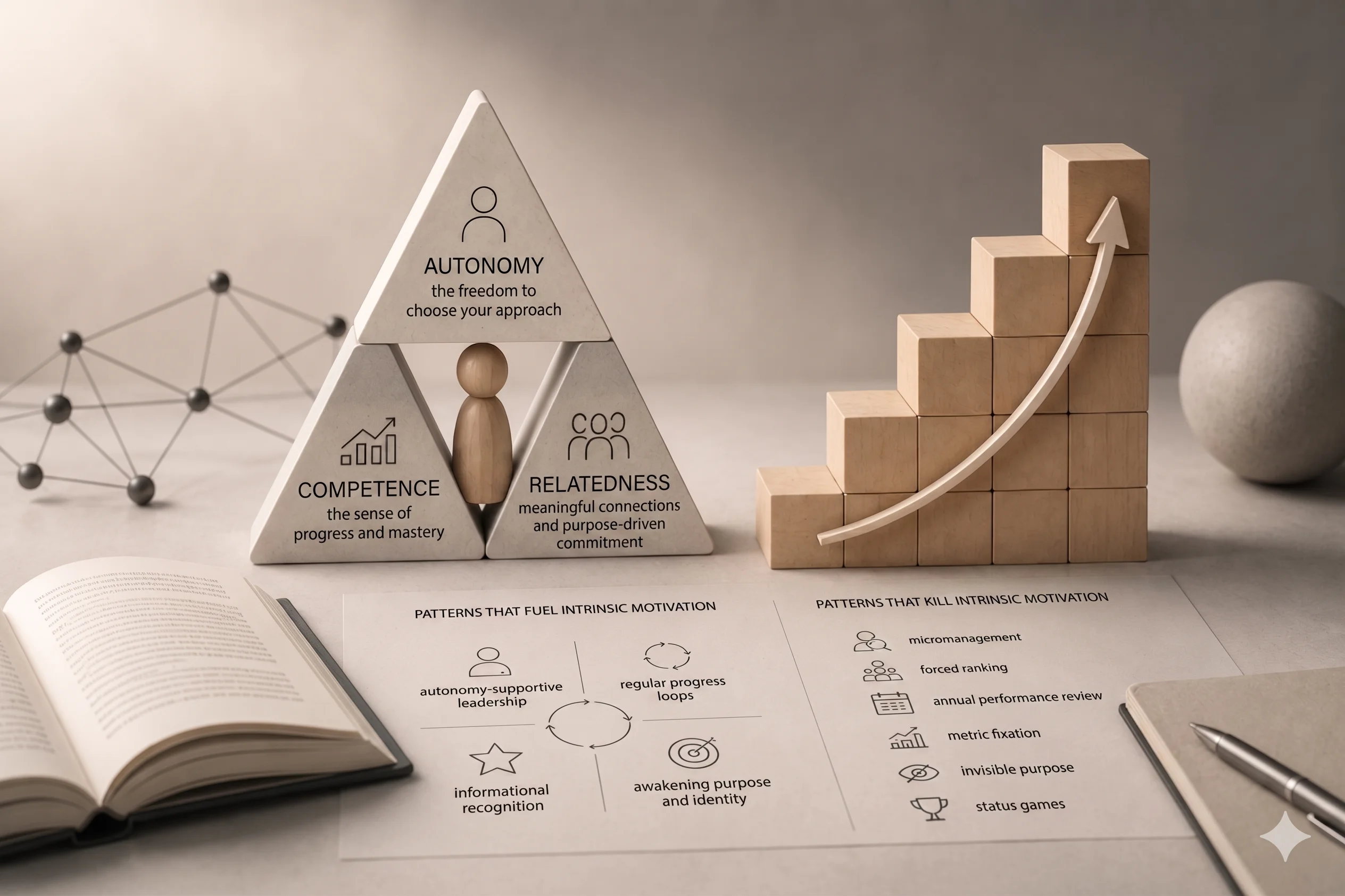
Intrinsic motivation is the drive to do something for its own sake, the sense of satisfaction, interest, or meaning that comes from within rather than from external rewards or punishments. At work, intrinsic motivation rests on three foundations: the freedom to choose how a task is done (autonomy), the sense of progress and skill development (competence), and meaningful connection to others and to a larger purpose (relatedness).
According to Self-Determination Theory developed by Edward L. Deci and Richard M. Ryan, intrinsic motivation produces far more sustainable performance than the short-term motivation generated by external incentives. Cho and Perry's 2012 study found that intrinsic motivation shows a substantially stronger association with engagement and reduced turnover intention than extrinsic reward expectancy. Poorly designed bonus systems, micromanagement, and evaluation processes that restrict autonomy, by contrast, quietly destroy this motivation.
Where External Incentives Fall Short
When motivation drops at work, the first solutions reached for are typically material: pay raises, bonuses, time off, additional perks. These tools are effective in some situations. But when the loss of motivation comes from inside, meaning when the employee's sense of meaning in their work has eroded, external incentives do not produce the expected result. For example, situations where giving frequent time off to an experienced employee thought to be exhausted only deepens the performance drop, and where subsequent pay offers fail to change the picture, are common on the ground. This pattern shows that rest or money alone is not enough to rekindle the inner spark.
This is because intrinsic motivation is not fed by a layer added from outside, but by an inner bond tied to why a person does the work in the first place. When this bond is gone, the material incentives that arrive afterward often destroy whatever sparks remain. In the academic literature this mechanism is called the overjustification effect.
The Scientific Foundation of Intrinsic Motivation
The modern scientific framework around intrinsic motivation is largely rooted in Self-Determination Theory, developed in the 1980s by Edward L. Deci and Richard M. Ryan. According to this theory, human behavior is not shaped solely by external rewards and punishments. Every person has three innate psychological needs, and when these needs are met, the person becomes self-driven from within. These three needs are autonomy, competence, and relatedness.
Autonomy is the sense of having a say over the method and pace of one's own work. Competence is the desire to develop and master a domain, and to see that development unfold. Relatedness is the feeling that one's work happens within meaningful relationships with others and contributes to a larger purpose. According to Deci and Ryan, when any one of these three needs is left unmet for a long period, intrinsic motivation gradually weakens.
In his 2009 book "Drive: The Surprising Truth About What Motivates Us", Daniel Pink brought this framework to a wide audience but proposed a slightly different triad: autonomy, mastery, and purpose. In Pink's model, autonomy and mastery largely overlap with SDT, but the dimension of relatedness is replaced by purpose. This shift may seem conceptually minor, but it matters: the social dimension that SDT highlights, the need to form meaningful connections with others, recedes into the background in Pink's frame.
In practice, this difference directly shapes how organizations approach intrinsic motivation. Organizations operating only with the autonomy-mastery-purpose framework often underweight an employee's social ties, the quality of their relationship with their manager, and the sense of belonging within the team. Recent field research, particularly in remote and hybrid work settings, shows that relatedness is the most fragile and the most critical component of intrinsic motivation.
Why Intrinsic Motivation Matters More Than Ever
In recent years, intrinsic motivation has moved from being an academic concept to a direct indicator of financial performance. Industry reports from McKinsey and similar consulting firms consistently find that intrinsically motivated employees show meaningfully higher scores on organizational commitment, job satisfaction, and performance. Cho and Perry's 2012 study, meanwhile, demonstrates that intrinsic motivation has a substantially stronger effect on employee engagement than extrinsic incentives do.
A 2024 field study published in Sustainability indicates that intrinsically motivated employees are significantly more productive not only in their defined duties, but also in what is called "extra-role" behavior. These behaviors include helping a colleague, spontaneously suggesting process improvements, supporting the team in a crisis, and other unwritten actions that form the actual core of an organization's output.
Another factor that makes this data critical is the changing makeup of the workforce. As of 2026, Generation Z employees have entered the workplace in large numbers and respond noticeably less to the traditional pay-bonus-promotion triad than previous generations. Meaningful work, autonomy over method, and a genuine path of development consistently rank above salary level for this group in workplace surveys. Remote work, accelerated by digital transformation, has also weakened the manager's direct control levers and made the presence or absence of intrinsic motivation far more visible.
As a result, intrinsic motivation, once considered a "nice-to-have" cultural topic, has become a priority tied directly to productivity, retention, and profitability. Understanding the mechanisms that build it or break it has become one of the essential capabilities of a modern manager.
The Three Psychological Needs
The three psychological needs defined by SDT form a complementary balance. The absence of any one of them puts the motivation supplied by the others at risk. For this reason, a manager who wants to build intrinsic motivation in the workplace must address all three without neglecting any.
The Three Core Needs of Intrinsic Motivation
Autonomy: The freedom to choose your own method
Autonomy is the employee's sense of having a say in how to reach a goal, the pace of work, and daily decisions. In an environment without autonomy, no matter how capable the employee is, they cannot feel the work as their own choice, and the inner bond gradually weakens. Google's "20% time" policy at one point allowed employees to spend a fifth of their week on areas of personal interest. It is widely known that the foundations of products like Gmail and AdSense were laid during this time. But autonomy doesn't always require such large structural decisions. A manager saying "decide how you want to do this" in a weekly meeting addresses the same need. What matters is that the employee feels like a decision-maker rather than an executor.
Competence: A sense of progress and growing skill
Competence is the experience of gradually mastering a domain and feeling that progress. People naturally invest more in work where they sense themselves developing. For this reason, regular feedback, making outcomes visible, and recording small wins play a decisive role in feeding the need for competence. In environments where the only feedback comes once a year through a formal review, the sense of competence weakens on its own. By contrast, quarterly or more frequent check-in meetings make progress toward goals visible and feed the competence need systematically. Competence should not be confused with external success: it is the visibility of progress, not the presence of a reward, that drives motivation.
Relatedness: Meaningful connection and shared purpose
Relatedness is the experience of doing work not in isolation but as part of a team, with a sense of contributing to something larger. According to SDT researchers, of the three needs, this is the easiest to overlook, the easiest to break, and the fastest to produce results. An employee whose manager genuinely listens in weekly one-on-ones, who shares a warmer social bond, and who is professionally supported, will be far stronger internally than another in the same material conditions. When relatedness weakens, autonomy turns into isolation, and competence becomes a meaningless personal achievement. In the case of the exhausted employee mentioned at the opening, what's often missing is exactly this: a thread of relatedness, kept alive through the manager, the team, or the organization's purpose, that connects the person to the work itself.
When Rewards Backfire: The Overjustification Effect
One of the most surprising findings in the intrinsic motivation literature is that well-intentioned rewards often fail to produce what is expected, and can in fact reduce motivation. This phenomenon is called the overjustification effect. Its foundation is Edward Deci's classic 1971 experiment using a cube puzzle called Soma. In the experiment, participants asked to solve the puzzle in exchange for money spent less time engaging with it than the control group. During the free period after the reward was removed, they did not return to the puzzle. The money had gradually displaced the original interest.
This phenomenon is not limited to laboratory conditions. A comprehensive three-wave field study of 304 employees across eight European countries found that individual variable pay for performance was perceived by employees as "controlling," and that this perception caused a meaningful decline in intrinsic motivation. Other field research consistently shows that small, frequent rewards tied to specific accomplishments outperform large annual lump-sum bonuses for knowledge work, where the controlling effect of large fixed payouts erodes intrinsic engagement over time.
But the subtlety here is often missed: rewards do not always destroy intrinsic motivation. According to Cognitive Evaluation Theory, developed by Deci and Ryan, what matters is how the reward is perceived by the recipient. A reward that is expected, tied to a contract, and aimed at shaping behavior is perceived as "controlling" and weakens intrinsic motivation. By contrast, an unexpected acknowledgment that arrives after an accomplishment and that carries information about the person's competence is perceived as "informational" and continues to feed intrinsic motivation. In other words, the same amount of money can either kill motivation or strengthen it depending on the frame in which it is offered.
The Same Reward, Two Diverging Paths
This distinction is critical for any organization designing compensation and bonus policies. Fixed, expected, performance-indexed systems can produce short-term output but erode the foundation of intrinsic motivation over time. By contrast, unexpected gestures that recognize competence and carry symbolic value strengthen an employee's inner connection to their work. The right question to ask is not "how much bonus should we offer," but "how will the employee perceive this bonus."
Patterns That Quietly Kill Intrinsic Motivation
Intrinsic motivation rarely dies because of a single major mistake. It dies because of unnoticed but recurring management patterns. The patterns below may look harmless in isolation, but when they appear together they visibly erode an employee's inner connection to their work.
- Micromanagement. Constant control, requiring approval for every detail, and denying initiative in method directly violate the need for autonomy. An employee under micromanagement gradually comes to see themselves as an executor rather than a decision-maker, and the inner bond weakens.
- Forced ranking and forced normal distribution. Evaluation systems that require employees to be distributed into preset percentages create zero-sum competition within the team. One person's high score depends on another's low score. This structure dismantles the bond of belonging and surrenders intrinsic motivation to competitive stress.
- Annual-only performance reviews. The need for competence is fed when progress is frequent and visible. In systems where feedback is compressed into a single formal review per year, the employee goes without concrete signals about their development throughout the year. This gap turns the experience of mastery into an anticipation of being judged.
- Goodhart's law. "When a measure becomes a target, it ceases to be a good measure." A single metric pushed onto an employee under pressure shapes behavior toward short-term maximization of that metric, while the actual quality of the work and its long-term value fall to the background. The same mechanism appears outside corporate performance too, anywhere creative output gets quantified, from academic publication counts to GitHub commit volume. This dynamic damages both the depth of motivation and the substance of the work.
- Invisible purpose. An employee who doesn't know how their work serves a larger picture is forced to draw motivation from pay or external incentives. Relatedness suffers most through this channel. The absence of transparent and regular communication about the work's purpose, customer impact, or organizational direction is one of the clearest sources of the quiet collapse of motivation.
- Status games and visible hierarchy pressure. An environment where performance is constantly compared with others and where status is renegotiated at every meeting produces more anxiety than intrinsic motivation. The employee works to prove themselves to others rather than for the natural arc of their own growth, which substitutes a performative display for the inner connection to the work.
Patterns That Feed Intrinsic Motivation
The patterns that keep intrinsic motivation strong are different in nature from those that destroy it. The point is not to build a one-directional incentive system, but to apply small daily practices that consistently feed all three psychological needs (autonomy, competence, relatedness). The four patterns below are the main channels of that feeding.
What Kills It vs What Feeds It
Autonomy-supportive leadership
An autonomy-supportive leader does not tell the employee "what to do," but asks them "what they want to accomplish, and how." They provide clarity on the goal but allow freedom of method on the path. A telling marker of this leadership style is that, in weekly one-on-ones, listening takes up more time than speaking. Removing obstacles in front of the employee proves more useful than imposing direction. This approach feeds both autonomy and relatedness, because the employee positions themselves not as an "executor" but as a "co-decision-maker."
Regular progress loops (mastery loops)
The need for mastery requires structures in which progress is visible. Quarterly goal cycles, weekly check-in meetings, and small moments of daily feedback make growth measurable. Systems where progress is visible continuously, rather than only at the annual review, keep one of the main channels of intrinsic motivation open. This structure is valuable not only for the manager but also for the employee. A person who can observe their own growth gradually escapes dependence on external incentives and begins to trust their own internal parameters.
Informational recognition
As Cognitive Evaluation Theory suggests, a piece of recognition feeds intrinsic motivation when it arrives in the form of "you did this work to this standard, and I noticed" rather than "here is your bonus." Informational sharing has three core components: it is specific, it is unexpected, and it carries signal about the person's competence. When these three conditions are met, even a small piece of recognition produces a stronger motivating effect than a large expected bonus. A short, specific acknowledgment from a manager in a weekly one-on-one often leaves a deeper mark than financial incentives.
Awakening purpose and identity
The deepest channel of intrinsic motivation is when an employee's work aligns with their own identity and values. A manager's job is not always to support; sometimes it is to hold up a mirror. For example, in cases where a new hire seems passive in their first months and doesn't fully step into the role, a direct and honest conversation from the manager, one that clearly signals belief in the employee's higher capacity and an explicit invitation to grow into it, can wake up the dormant motivation inside. This works through internal recognition, not through external pressure. Within a few years, that same employee can move far from their initial passive picture. They handle every responsibility they're given and may grow into one of the leading names in the company.
Where Goal-Setting Systems Fit: The OKR Question
The discussion of intrinsic motivation eventually arrives at a practical question: do goal-setting systems, and OKRs in particular, feed intrinsic motivation, or kill it? Field experience offers ample examples in both directions. When set up correctly, the OKR structure can support autonomy, competence, and relatedness simultaneously. When set up wrong, the same structure turns into top-down pressure, salary-indexed stress, and a performance tool that pits individuals against each other. For this reason, the answer to "are OKRs good or bad for motivation" lies not in the structure itself but in how it is configured.
OKR setups that feed intrinsic motivation share a few common traits. First, teams shape their own key results through their own discussion, rather than copying them from above. This practice directly feeds autonomy. Second, transparency of objectives across the organization, paired with team members being able to see how their work creates value for others, strengthens the bond of belonging. Third, the quarterly cycle and its supporting check-in meetings make progress continuously visible, which feeds competence systematically. When these three practices come together, the OKR structure becomes a mechanism that strengthens intrinsic motivation rather than the traditional annual review model.
By contrast, poorly configured OKR practices do far worse than fail to feed intrinsic motivation, they actively damage it. Top-down imposed key results that cannot be changed violate the need for autonomy and leave the employee with a sense of being unable to own their own targets. Tying scores directly to pay raises or bonuses is a more fundamental mistake and triggers the overjustification effect. The employee gradually starts working not because the goal feels meaningful, but to avoid losing the bonus, and intrinsic motivation gives way to conditional external incentives. A third common error is using OKRs to weed out low-scoring employees, turning the structure into a punishment tool, which dismantles relatedness and psychological safety.
From the perspective of intrinsic motivation, a well-configured OKR system has the following traits: the team shapes its own key results, progress is made visible through regular feedback loops, and scores are used as a learning instrument rather than a verdict. When the foundational principles of OKR are designed with this framework in mind, goal-setting becomes a mechanism that feeds rather than destroys intrinsic motivation. In practice, this means the manager's responsibility is not only to set goals but to keep the autonomy-competence-relatedness triad continuously active around them.
Intrinsic motivation is shaped less by an organization's strategy than by its daily management practices. What determines whether an employee comes to work willingly on a given morning is not the size of the goal board, but whether their manager makes space for them, whether their progress is visible, and whether they can build a meaningful relationship with the team they belong to. Organizations that consistently answer "yes" to those three questions succeed at building intrinsic motivation through structure, not through words.
Frequently Asked Questions
What is intrinsic motivation?
Intrinsic motivation is the drive to do something for its own sake, based on the inner sense of satisfaction, interest, or meaning that comes from within rather than from outside rewards or punishments. At work it is fed by three core sources: the freedom to choose one's method (autonomy), the desire to develop oneself (competence), and meaningful connection and purpose (relatedness). When these three are met, high performance emerges without the need for external incentives.
What's the difference between intrinsic and extrinsic motivation?
Intrinsic motivation is when a person does work out of their own interest, meaning, or satisfaction. Extrinsic motivation is the action created by outside outcomes like money, promotion, recognition, or punishment. Intrinsically motivated employees tend to deliver more sustainable and creative performance over time. Extrinsic motivation is more effective in the short term and for specific tasks. Cho and Perry's 2012 study shows the effect of intrinsic motivation on employee engagement is substantially stronger than that of extrinsic incentives.
How do you increase intrinsic motivation at work?
By systematically feeding the three core needs. For autonomy, give employees room to choose their method on the way to a goal. For competence, make progress visible through regular feedback, quarterly cycles, and frequent check-ins. For relatedness, genuinely listen in one-on-ones, hold team-wide transparency, and connect work to a larger purpose. Informational recognition, when it is specific and unexpected, feeds intrinsic motivation especially strongly.
What are examples of intrinsic motivation at work?
Typical examples include a developer learning a new technology on their own initiative, a sales rep enjoying the act of building a real relationship with a customer, a designer suggesting improvements that aren't in the spec, a teammate quietly helping a colleague in a difficult moment, or a manager making space to genuinely listen in weekly one-on-ones. What these behaviors share is that they happen without expectation of an external reward.
Do bonuses kill motivation?
Not always, but they can when designed wrong. The overjustification effect shows that expected rewards tied to controlling behavior gradually displace inner interest. Small, frequent rewards that recognize competence threaten intrinsic motivation far less than large expected annual payouts.
How do OKRs affect intrinsic motivation?
They can go both ways, and the configuration decides which. An OKR setup where teams shape their own key results, where progress is visible through regular check-in meetings, and where scores are used as a learning instrument feeds intrinsic motivation systematically. By contrast, an OKR practice that is imposed top-down, indexed to pay, and used to weed out low scorers violates the needs for autonomy and relatedness, and directly damages motivation.
Start Using DevOKR Today, Free
Turn what you've read into action. Write your first OKR in minutes, free for small teams.