Performance Reviews: A Complete Guide for Managers and HR

 OKR-BOK™ Certified Coach
A performance review is a structured look at how well someone did their job over a period, followed by a conversation about what comes next. Done well, it gives people a clear picture of where they stand and gives the organization fair input for pay, promotion and development decisions.
Most reviews fall short of that. Ratings often say more about the manager than the employee, and the meeting at the end changes little. This guide covers the parts that decide whether a review works: what to evaluate, how to run the cycle, how to rate fairly and how to hold the conversation.
What is a performance review?
A performance review, also called a performance appraisal or performance evaluation, compares what an employee delivered against what was expected of them. It usually covers two things: results, meaning what the person achieved, and behaviors or competencies, meaning how they achieved it. Many organizations run a formal review once or twice a year, often with lighter check-ins in between.
It helps to keep three things apart that are often blended into one meeting:
- Evaluation: a judgment of past performance against agreed expectations, recorded as a rating or a written assessment.
- Feedback: information that helps someone improve, ideally given throughout the year, not saved for the review.
- Decisions: pay, bonus, promotion and development choices that use the evaluation as one input.
When all three are squeezed into one annual meeting, the conversation tends to become a defense of the rating. Separating them, at least in time, leaves room for an honest discussion about growth.
Types of performance reviews
There is no single right format. Most organizations combine two or three of the types below, for example an annual review supported by quarterly check-ins and a self-evaluation.
| Type | How it works | Best for | Watch out for |
|---|---|---|---|
| Annual review | One formal review at year end, usually tied to pay decisions. | Organizations that need one consolidated rating per year. | Recency bias and long gaps without feedback. |
| Quarterly or periodic review | Shorter reviews every quarter or half year. | Fast-moving goals and teams that plan in quarters. | Form fatigue if each review is as heavy as an annual one. |
| Continuous check-ins | Regular one-on-ones with no formal rating. | Coaching, course correction and evidence for the formal review. | Notes get lost if nothing is recorded. |
| Self-evaluation | The employee rates their own performance before the manager does. | Surfacing context the manager may have missed. | Self and manager views often differ, so the gap needs discussion. |
| 360° review | Ratings from the manager, peers, direct reports and sometimes customers. | Leadership and collaboration behaviors that one manager cannot see. | Rater fatigue and ratings used for pay when meant for development. |
| Project-based review | A short review at the end of each project or engagement. | Consulting, agencies and matrix teams with changing leads. | Fragmented views unless someone pulls them together. |
What to evaluate: results and competencies
A review that only looks at results rewards people who got the easiest goals. A review that only looks at behaviors rewards people who are pleasant to work with but deliver little. Most frameworks therefore use two dimensions with separate evidence.
- Results: goal outcomes, key results, delivered projects, quality and customer measures for the period.
- Competencies: observable behaviors the role requires, such as collaboration, decision making or leadership, rated against a shared definition.
Each dimension gets a weight that fits the role. A sales role may lean toward results, a team lead role toward leadership behaviors. Agree the weights before the period starts, not when the ratings are already in.
Where OKRs fit
If your teams use OKRs, OKR scores are one of the best sources of evidence on the results side. They show what the person committed to, how ambitious it was and what they delivered. They should not become the whole formula, though.
Stretch objectives are designed to land around 60 to 70 percent. If that score flows straight into pay, people stop setting ambitious goals. This is why OKRs should not be tied directly to performance reviews. The practical answer is to treat OKR results as evidence the manager reads and weighs, alongside the difficulty of the goal and the context of the quarter, rather than a number copied into the rating.
Good evidence starts long before the review: well-run OKR cycles give it clear goals, regular check-ins and honest scores to work with.
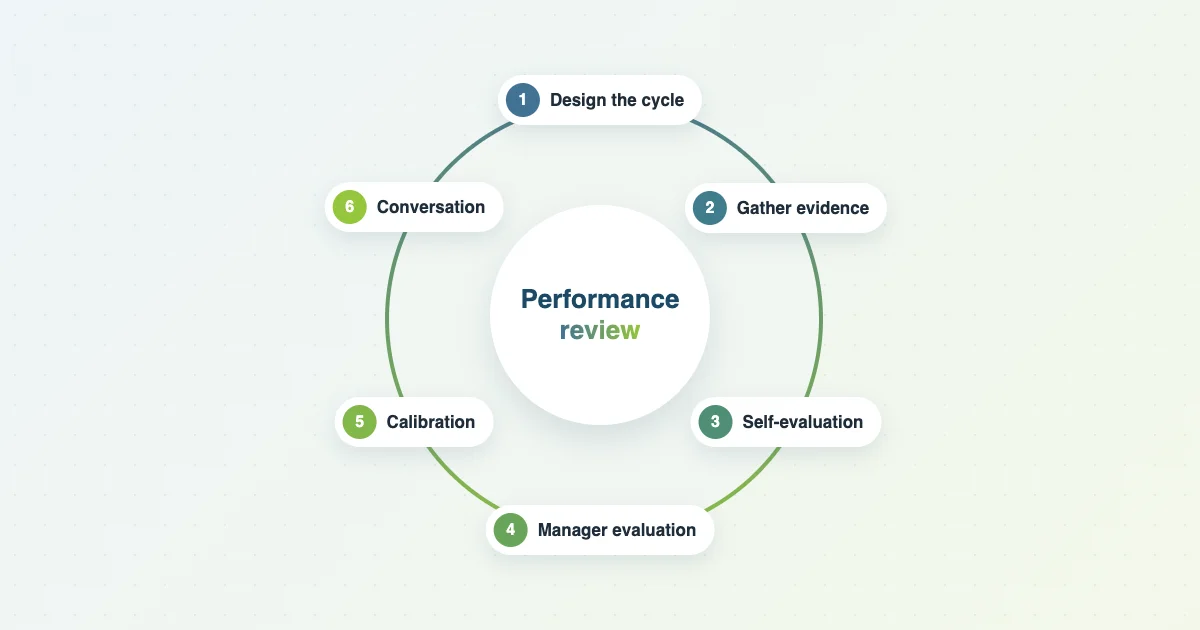
The performance review cycle, step by step
Whatever the format, a review that holds up follows the same six steps. Skipping the early ones is the most common reason the later ones go wrong.
- Design the cycleSet the period, who reviews whom, which sources feed each dimension, the weights and the rating scale. Publish it before the period starts.
- Gather evidence all periodGoal progress, examples of work, feedback received and notes from one-on-ones. A review written from memory favors the last few weeks.
- Self-evaluationThe employee rates themselves first, against the same criteria, and adds context the manager may not know.
- Manager evaluationThe manager rates each dimension against the evidence and writes a short reason for each rating.
- CalibrationManagers compare ratings across teams so the same performance gets the same rating, whichever manager gave it.
- Conversation and follow-upDiscuss the result, agree two or three priorities for the next period and check on them in regular one-on-ones.
Self-evaluation
Expect self and manager ratings to differ. A meta-analysis of self, peer and supervisor ratings found only a moderate correlation between self and supervisor ratings, while peer and supervisor ratings agreed much more closely.[1]
The gap is not a problem to hide but the best material for the conversation. Keep the self-evaluation independent by not showing the manager's rating until both are complete.
Writing review comments that help
A rating without a reason is hard to accept and impossible to calibrate. Good comments name the behavior, give an example and point to what comes next. Compare:
| Vague | Specific |
|---|---|
| Great team player. | Took over onboarding for two new engineers in Q3 and wrote the setup guide the team still uses. |
| Needs to improve communication. | Status updates on the migration came after deadlines had slipped twice. Next quarter: raise risks in the weekly meeting as soon as they appear. |
| Exceeded expectations. | Reached 118% of the annual sales target, with three of the five largest deals coming from accounts opened in the first half. |
The specific version takes a minute longer to write and saves a long argument in the meeting.
Calibration
Calibration works, with a catch. A study of a multinational firm found that calibration committees reduced lenient ratings but pushed more people toward the middle of the scale.[2]
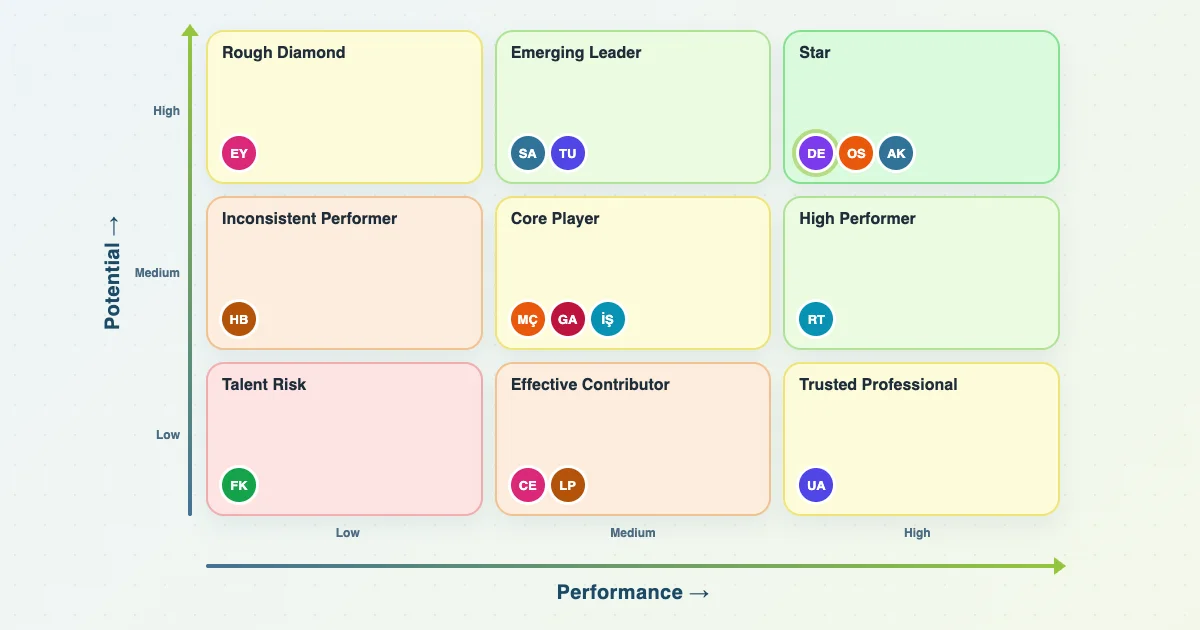
Ask for evidence behind middle ratings as well as extreme ones. Many organizations also bring performance and potential together on a 9-box grid during calibration, which turns the review into an input for development and succession decisions.
Rating scales and how to choose one
The scale shapes how managers think about the rating. Three formats cover most needs:
A 1 to 5 or 0 to 100 score. Easy to combine and weight, but the numbers mean different things to different managers unless each level is defined.
Example: 4 out of 5
Labels such as Below expectations, Meets expectations, Exceeds expectations. Easier to explain to employees, harder to average.
Example: Exceeds expectations
Each level is anchored by a description of what someone at that level actually does. Takes more work to build, but gives managers the clearest shared reference.
Example: Level 4: Shares updates before being asked and flags risks early.
Whatever the format, write down what each level means for your organization. A scale without definitions is where most rating disagreements start.
Fair reviews: what distorts ratings
The uncomfortable finding behind most review reform is that ratings measure the rater as much as the person rated. In a study of more than 4,000 managers who were each rated by two bosses, two peers, two direct reports and themselves, the rater's own rating tendencies accounted for 62% and 53% of the variance in ratings in the two data sets. The person's actual performance accounted for only 21% and 25%.[3]
Every manager brings habits to the rating. The most common ones are easy to name:
- Leniency: rating everyone high to avoid difficult conversations.
- Central tendency: putting almost everyone in the middle.
- Recency: letting the last few weeks outweigh the whole period.
- Halo: letting one strong or weak trait color every dimension.
- Similar to me: rating people who work like the manager more favorably.
None of these disappear with training alone. What reduces them is structure: defined scales, evidence gathered during the period, written reasons for each rating, more than one perspective and a calibration step where managers question each other.
Holding the review conversation
Feedback does not automatically improve performance. A meta-analysis of feedback interventions found that feedback improved performance on average, but more than a third of the interventions made performance worse. Feedback lost its effect when it pulled attention away from the task and toward the person's self-image.[4]
That points to a simple rule for the review: talk about the work and what happens next, not about the person's worth. A structure that keeps the meeting on track:
- Open with their view. Ask what they are most proud of and where they got stuck before sharing your rating.
- Walk through the evidence. Use specific examples for each dimension, and explain where your view differs from the self-evaluation.
- Agree on two or three priorities. More than that rarely survives the next quarter.
- Set the follow-up. Put the first check-in in the calendar before the meeting ends.
The review conversation is easier when it is not the only one. Teams that build a habit of regular feedback during the year rarely face surprises at review time.
From the annual ritual to continuous reviews
The classic annual review is expensive and often unconvincing. When Deloitte tallied the time it spent on forms, meetings and ratings, it came to close to 2 million hours a year. A Gallup analysis found that only 14% of employees strongly agree their performance reviews inspire them to improve.[5][6]
The response in many organizations has not been to drop reviews but to change their shape: shorter and more frequent reviews, goals that are visible and updated during the year, and a clearer line between development conversations and pay decisions. The differences between traditional performance management and OKR show where that shift comes from.
Rewards matter too. When reviews exist mainly to decide bonuses, they can crowd out the intrinsic motivation that keeps people engaged in the first place.
A performance review is only as good as the system around it. Clear expectations at the start of the period, evidence gathered along the way, ratings that are defined and calibrated, and a conversation that looks forward matter more than the form itself.
Start with the step your organization skips most often. For most teams that is the first one: agreeing what good looks like before anyone is rated.
Frequently Asked Questions
What is a performance review?
A performance review is an assessment of what an employee delivered over a period, and how, against expectations agreed in advance. It usually covers results and competencies, is recorded as a rating or written assessment and ends with a conversation with the employee.
How often should performance reviews be done?
Many organizations run one or two formal reviews a year and support them with quarterly or monthly check-ins. Teams that plan goals by quarter often do better with short quarterly reviews. What matters more than frequency is regular feedback and evidence gathering between reviews.
What should a self-evaluation include?
A self-evaluation should use the same criteria as the manager: the outcome against each goal, specific examples, context the manager may not know and the areas where support is needed next period. To keep it independent, the manager's rating should stay hidden until both are complete.
What is a calibration meeting?
In a calibration meeting, managers review ratings together across teams so the same performance gets the same rating whichever manager gave it. Research shows calibration reduces lenient ratings but can push ratings toward the middle, so middle ratings need evidence too.
How do you make performance reviews fair?
Ratings reflect the rater as much as the person rated. To reduce that effect, use a scale with defined levels, gather evidence during the period, require a written reason for each rating, include more than one perspective and add a calibration step where managers question each other.
Should OKRs be part of performance reviews?
OKR results are good evidence for a review but should not be the whole formula. Stretch objectives are designed to land around 60 to 70 percent, so if the score flows straight into pay, people stop setting ambitious goals. It works better when the manager weighs OKR results together with the difficulty of the goal and the context of the period.
Sources
- ↑ Harris & Schaubroeck, Personnel Psychology, A Meta-Analysis of Self-Supervisor, Self-Peer, and Peer-Supervisor Ratings (1988)
- ↑ Demeré, Sedatole & Woods, Management Science, The Role of Calibration Committees in Subjective Performance Evaluation Systems (2019)
- ↑ Scullen, Mount & Goff, Journal of Applied Psychology, Understanding the Latent Structure of Job Performance Ratings (2000)
- ↑ Kluger & DeNisi, Psychological Bulletin, The Effects of Feedback Interventions on Performance: A Historical Review, a Meta-Analysis, and a Preliminary Feedback Intervention Theory (1996)
- ↑ Buckingham & Goodall, Harvard Business Review, Reinventing Performance Management (2015)
- ↑ Sutton & Wigert, Gallup, More Harm Than Good: The Truth About Performance Reviews (2019)
Start Using DevOKR Today, Free
Turn what you've read into action. Write your first OKR in minutes, free for small teams.