30-60-90 Day Plan for New Hires: A Manager's Guide

A 30-60-90 day plan breaks a new employee's first three months into three phases: learn the role in the first 30 days, contribute with support by day 60, and own a defined piece of work by day 90. Each phase has a few milestones, and every milestone has an observable result, an owner and a date.
The hiring manager writes the plan, not the new hire, and the two revise it together in the first week. Weekly one-on-ones keep it moving, and short reviews at day 30, 60 and 90 decide what changes next.
What a 30-60-90 day plan is, and who writes it
Search for a 30-60-90 day plan and most results are written for job candidates who bring one to an interview. This guide covers the other version: the plan a manager prepares for someone who has already accepted the offer. The candidate's plan is a pitch. The manager's plan is a commitment about the first three months: what the new hire will learn, who they will meet and what they will deliver.
That makes the plan a realistic preview of the job, given after the hire rather than before it. A meta-analysis of 52 studies found that realistic job previews reduce voluntary turnover mainly by signalling that the organization is honest with its people, and that a written or spoken preview delivered after hiring may be the most effective design.[1] A plan with concrete milestones is exactly that kind of preview.
Why the first 90 days carry so much weight
Research on how newcomers settle in points to three signs of a good start: the person knows what is expected of them (role clarity), believes they can do the work (self-efficacy) and feels accepted by the team (social acceptance). A meta-analysis of 70 samples found that these three measures carry the effect of onboarding practices through to job satisfaction, commitment, performance, intention to stay and turnover.[2]
Expectations matter just as much. In a meta-analysis of 31 studies covering more than 17,000 people, the degree to which a job matched what new hires expected was related to their satisfaction, commitment and intention to leave.[3] A manager who spells out the first three months leaves less room for a gap between the job people imagined and the one they found.
Practitioner data points the same way. In a 2025 survey of 1,000 HR leaders in the US, the UK and Australia by the onboarding software vendor Enboarder, one of the top reasons HR leaders gave for departures within 90 days was a mismatch between job expectations and reality (30.3%). The same survey found that 44.8% of organizations provide only general guidelines for a 30-60-90 day plan.[4]
A 30-60-90 day plan works on all three signs at once: milestones make the role clear, early wins build confidence, and relationship milestones turn introductions into part of the job instead of a matter of luck.
Three phases: learn, contribute, own
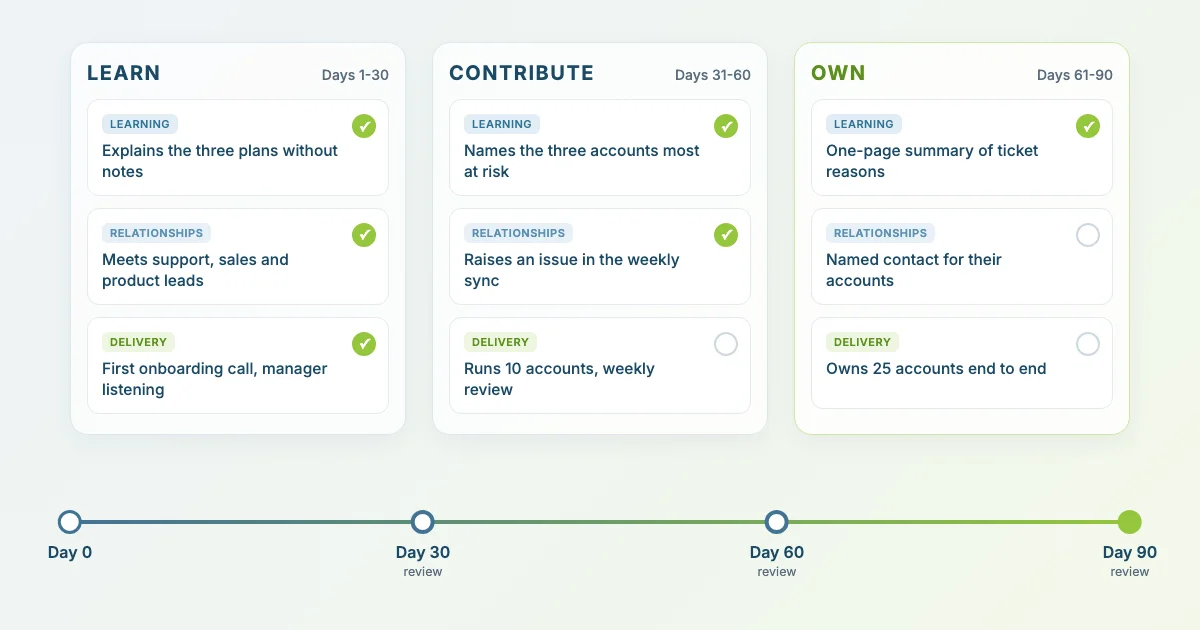
The three phases are not equal blocks of work. The first is mostly input, the last is mostly output, and the balance shifts in the middle. The diagram shows how responsibility moves from the manager to the new hire across the 90 days.
Responsibility moves from the manager to the new hire
Days 1-30: learn
The goal of the first month is context. The new hire learns the product, the customers, the tools and how decisions get made, and meets the people they will depend on. Delivery goals stay small and safe: one task that can be finished with help and that shows how work flows through the team. The manager is the most active person in this phase, opening doors and answering questions.
Days 31-60: contribute
In the second month the new hire takes on real work with support close at hand. They own tasks instead of shadowing them, ask for review before shipping and start to share their own observations. Someone new notices friction the team has stopped seeing, so this is a good moment to ask for a short written list of what looked odd.
Days 61-90: own
By the third month the new hire owns a defined piece of work end to end: a customer portfolio, a process or a component. Support moves from daily to weekly, and the conversation shifts from what they are learning to what they are delivering and what they would change. The day-90 review closes the onboarding plan and opens the person's regular goals.
Three kinds of milestones in every phase
Each phase needs milestones of three kinds. Learning milestones cover what the person has to understand, relationship milestones cover who they need to know and work with, and delivery milestones cover what they produce. A plan with only delivery goals turns onboarding into an exam. A plan with only learning goals leaves the new hire with nothing to show at day 60.
Every milestone needs an observable result (something a third person could check), an owner and a date. "Understands our pricing" is not observable. "Explains the three plans and their limits to a colleague without notes" is. The table shows an example plan for a customer success specialist.
| Phase | Milestone type | Done when | Owner | By |
|---|---|---|---|---|
| 1-30 | Learning | Walks a colleague through the three plans and their limits without notes. | New hire | Day 14 |
| 1-30 | Relationships | Has met the support lead, the account executive for their region and one product manager, and noted how work passes between the teams. | Manager | Day 20 |
| 1-30 | Delivery | Runs an onboarding call with a small customer while the manager listens in. | New hire | Day 30 |
| 31-60 | Learning | Reads the account health dashboard and names the three accounts most at risk, with reasons. | New hire | Day 40 |
| 31-60 | Relationships | Joins the weekly support and product meeting and raises one customer issue there. | New hire | Day 45 |
| 31-60 | Delivery | Handles a portfolio of 10 accounts, reviewed weekly with the manager. | Manager | Day 60 |
| 61-90 | Learning | Writes a one-page summary of why customers in their portfolio open support tickets most often. | New hire | Day 75 |
| 61-90 | Relationships | Support and sales treat them as the contact person for their accounts. | Manager | Day 75 |
| 61-90 | Delivery | Owns the full portfolio of 25 accounts and runs quarterly business reviews without the manager in the room. | New hire | Day 90 |
The manager drafts the plan before day one. In the first week, the manager and the new hire go through it together and fix whatever is unrealistic or missing. The new hire should leave that meeting able to say, in their own words, what success at day 90 looks like.
Day zero: what has to be ready before the first morning
The plan starts before the new hire arrives. Anything that is not ready on the first morning eats into the first week, and the first week sets the tone for the ones after it.
- Accounts, equipment and access to every tool the plan mentions.
- A written draft of the 30-60-90 day plan, shared on day one.
- The first week's calendar, including the introductions from the relationship milestones.
- A buddy outside the reporting line who can answer the questions people hesitate to ask their manager.
- The weekly one-on-one booked for all 90 days.
Weekly one-on-ones and the day 30, 60 and 90 reviews
The plan moves forward in weekly one-on-ones. Half an hour is enough: which milestones are done, which are stuck, what the new hire needs and what they have noticed. As with OKR check-in meetings, the value comes from regularity, not from length.
At day 30, 60 and 90 the manager holds a longer review. The SHRM Foundation's onboarding guidelines recommend checking in on progress at milestones such as 30, 60, 90 and 120 days, and up to a year after the start date.[5] Each review looks back at the milestones of the phase, agrees what carries over and sets the next phase's milestones in more detail. The day-90 conversation is not a formal performance review: it closes the onboarding plan and hands the person over to the regular goal and feedback cycle.
A short pulse survey alongside each review gives the new hire a second channel. Three to five questions are enough, for example:
- Did the training and information you received this month help you do your job?
- Are you getting the support you need from your manager?
- Do you feel part of the team?
- Can you see yourself working here a year from now?
The manager should not be the only voice. By day 60 a new hire has worked with several colleagues, and asking two or three of them for short feedback gives a fuller picture than one person's impression. This matters most when the review also decides whether the employment continues.
Line up the reviews with the probation period
Many contracts start with a probation period during which either side can end the employment on shorter notice. Its length depends on local law and the contract, and it often does not match 90 days.
Check the date before writing the plan. If the probation period ends before day 90, the review closest to that date becomes the probation decision, and it has to happen early enough to act on. Put that review in the plan with its real date, tell the new hire which conversation it is, and collect feedback from colleagues before it rather than after.
A 30-60-90 day plan is not an OKR
Both use goals and dates, so the two are easy to confuse. OKRs describe what the organization wants to change this quarter. Teams and individuals write their own OKRs too, and a good share of them come bottom-up, but they are all aligned by how they contribute to the company's strategy. A 30-60-90 day plan describes how one person becomes productive in a new role: it tracks getting up to speed, not a business outcome for the quarter. That is why most of its milestones, such as meeting the support lead or learning the pricing model, would make poor key results.
The two meet at the end of the plan. The delivery milestones of the third phase are often the new hire's first contribution to a team objective, and the day-90 review is a natural point to write their first OKRs together with the manager. From then on, the weekly one-on-ones that carried the onboarding plan carry the person's goals and feedback.
Where 30-60-90 day plans usually go wrong
- Copying a generic template. A plan that would fit any role makes no role clear. Write milestones for this job, this team and this quarter.
- Only delivery goals. Without learning and relationship milestones, the plan becomes a performance test from the first day.
- Milestones nobody can check. "Gets familiar with the codebase" cannot be reviewed. "Ships one small fix through code review" can.
- Writing it alone. A plan the new hire has never discussed is the manager's expectation, not a shared one.
- Letting the reviews slip. When the day-30 review moves to day 45, the plan loses its dates and turns into a wish list.
- Stopping at day 90 with nothing next. The plan should end with the person's regular goals in place, not with silence.
A good 30-60-90 day plan is short, specific and shared. It tells the new hire what the first three months hold, gives the manager a reason to talk every week, and turns the first quarter in a new job into something both sides can see and adjust.
Frequently Asked Questions
What should a 30-60-90 day plan for a new employee include?
Three phases: learning in the first 30 days, contributing with support by day 60 and owning a defined piece of work by day 90. Each phase has three kinds of milestones: learning, relationships and delivery. Every milestone needs an observable result, an owner and a date. Weekly one-on-ones and reviews at day 30, 60 and 90 keep the plan moving.
Who writes the 30-60-90 day plan, the manager or the new hire?
The manager drafts it before the new hire's first day. In the first week, the two go through it together and fix whatever is unrealistic or missing. The 30-60-90 plan a candidate brings to an interview is a different thing: that one is a pitch, while the manager's plan is a commitment about the first three months.
What are good 30-day goals for a new employee?
First-month goals should be small and checkable. For example: explain the product's plans to a colleague without notes, meet the three or four people you will work with most and note how work passes between teams, and finish one small task end to end with the manager watching. Write results a third person could check, not vague goals such as getting familiar with something.
What questions should a new hire survey ask at day 30, 60 and 90?
Three to five questions are enough. The usual themes are training, manager support, belonging and intention to stay. For example: did this month's training and information help you do your job, are you getting the support you need from your manager, do you feel part of the team, and can you see yourself working here a year from now?
What if the probation period ends before day 90?
Then the review closest to the end of probation becomes the decision point, and it has to happen early enough to act on. Put it in the plan with its real date, tell the new hire which conversation it is, and collect feedback from colleagues beforehand, so the decision does not rest on one person's impression.
How is a 30-60-90 day plan different from OKRs?
OKRs describe what the organization wants to change this quarter. Teams and individuals write their own OKRs too, but they are aligned by how they contribute to the company's strategy. A 30-60-90 day plan tracks how one person becomes productive in a new role. The two meet at the end of the plan: the day-90 review is a natural point for the new hire to write their first OKRs with the manager.
Sources
- ↑ Earnest, Allen & Landis, Personnel Psychology, Mechanisms linking realistic job previews with turnover: A meta-analytic path analysis (2011)
- ↑ Bauer, Bodner, Erdogan, Truxillo & Tucker, Journal of Applied Psychology, Newcomer adjustment during organizational socialization: A meta-analytic review of antecedents, outcomes, and methods (2007)
- ↑ Wanous, Poland, Premack & Davis, Journal of Applied Psychology, The effects of met expectations on newcomer attitudes and behaviors: A review and meta-analysis (1992)
- ↑ Enboarder, Winning the First 90 Days: survey of 1,000 HR leaders (onboarding statistics) (2025)
- ↑ SHRM Foundation (Talya N. Bauer), Onboarding New Employees: Maximizing Success (2010)
Start Using DevOKR Today, Free
Turn what you've read into action. Write your first OKR in minutes, free for small teams.